In the first part, dedicated to the steps to verify a family legend, this second part puts into practice a concrete research with the recommendations associated with the various tools of the old press.
As a reminder, in the first part of the article, I explained the different elements of the family history regarding François Mouyon, my great-great-grandfather.
When he was young and working in a menagerie in Lyon[1], François Mouyon was said to have been negligent in supervising the lion's cage, which led to an accident in which a person was injured. Following this event, he was sentenced to a prison term.
Family research in the old press
Once the genealogical research is conducted, we have a clearer idea of how François Mouyon lived over the years. It is then time to move on to research in the press.
To do this, it is advisable to start with fairly macro tools to cast a wide net. We can try different combinations by alternating his name and his commonly used first names as observed in the censuses and civil status administrative documents:
RetroNews:


Search “mouyon”, RetroNews Search “mouyon joseph”, RetroNews
We find that a search that is too broad like mouyon gives us 383 results, while a too restrictive one like mouyon françois or mouyon joseph has ten or eight results. We can of course consult all the articles, but this can be time-consuming. The idea is to find the right keywords to locate what we are looking for.
If we summarise the story we want to verify through the press, here are the key points:
The event took place in Lyon: We can try the Lyon filter, but this could prove too restrictive if the event actually occurred elsewhere.
He was young, so we can consider a period between the ages of 15 and 45 to cast a wide net, that is, between 1887 and 1917.
The story mentions a lion: the same caution applies, as the animal in question could have been different.
We could also use quotation marks in the search. For example, “joseph mouyon” to find the exact combination of these words in sequence, but I think this is not a good idea since he has different first names. I recommend not including a first name because especially the surname is used in many articles. If he were only referred to as Mouyon, the article would not appear when searching with a first name.
How to optimise your search keywords in the old press?
The notable element of the story being a lion, this is, according to my first impression, the right search to attempt first as it is what our story is based on and it would certainly be mentioned in the article if an event involving a lion had taken place.
With the search “mouyon lion”, meaning to find any article that contains both mouyon and lion on the page, there is only one result which is inconclusive because mouyon and lion are located in different parts of the newspaper page. If we search for “mouyon lyon”, there are ten inconclusive results. Therefore, the lion option is not the right one.
It was then that a crucial element, reported by my mother, made complete sense: the family story took place in a menagerie, not in a zoo. This type of precision is essential in genealogy and in press research, as “mouyon zoo” yields no results, while the filter “mouyon menagerie” reveals three key leads that will illuminate the description of a story that captivated newspapers from many corners of France and beyond for several months.

Excerpt search “mouyon menagerie”, RetroNews
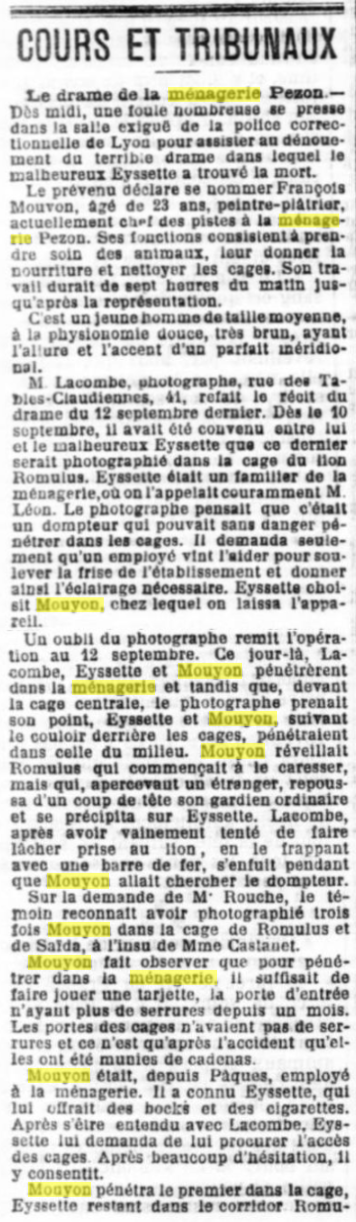
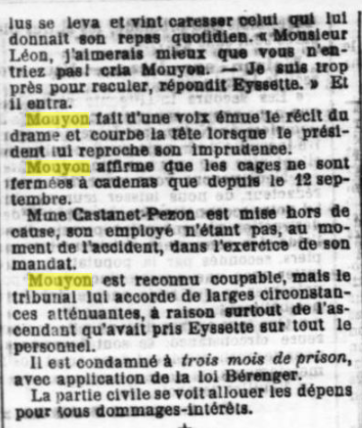
First of all, we note that technically the OCR process will scan the article and highlight the words we have identified, namely “mouyon” and “menagerie”. This is how it presents it to us in the search on RetroNews.
Thanks to the facts mentioned in this article, we find that the family story is well confirmed and has not been distorted even more than a hundred years later, which is not always the case since many stories are altered to present a more far-fetched truth.
In order to present the facts without forgetting anything, Irecommend using the following method :
Analysis of the article according to the QQOQCP method
Who?
A man named Léon Eyssette wanted to be photographed with the lion from a menagerie.
Mouyon is the employee of the menagerie.
Lacombe is the photographer.
The menagerie is called Castanet-Pezon.
Romulus, the lion of the menagerie.
What? How?
Eyssette was killed by the lion named Romulus.
Since Easter 1895, the employee Mouyon had been the ringmaster; his role from 7 a.m. until after the performance was to take care of the animals, feed them, and clean the cages.
Mouyon's role was to help Eyssette enter the cage. Eyssette asked him to lift a decorative strip of fabric hanging at the top of the façade to get the necessary lighting for the photo. The photographer was in front of the central cage, and Eyssette and Mouyon went into the cage. Mouyon woke the lion. However, upon seeing a stranger (Eyssette), the animal knocked Mouyon aside with a headbutt before attacking Eyssette. The photographer tried to make the lion let go with a metal bar while Mouyon went to fetch the tamer.
Where?
In the cages of a menagerie.
The judgement in the cramped courtroom of the correctional police in Lyon.
When?
The events took place on 12 September.
The newspaper and the judgement are dated 14 October.
How much?
Mouyon is sentenced to three months in prison under the Bérenger law and must pay damages.
Why?
Mouyon knew Eyssette because he offered him drinks and cigarettes. He asked him for access to the cages, which he consented to after much hesitation.
During the trial, Mouyon specified that to enter the menagerie, it was enough to slide a bolt. The entrance door and the cage doors had not had locks for a month. He would have entered before Eyssette and shouted at him not to come in. The latter would have told him that he was too close to back away.
The Castanet-Pezon menagerie is cleared of any involvement since the employee was not on duty at the time of the events. Mouyon is found guilty with significant mitigating circumstances due to the fact that Eyssette had gained influence over the staff.
Additional details:
Mouyon is a plasterer, of average height with a gentle appearance, very dark, having the look and accent of a perfect southerner.
The photographer is named Mr. Lacombe, he is at 41 Rue des Tables Claudiennes. He had photographed Mouyon three times just before the incident.
This article is a goldmine for genealogists and provides numerous explanations about history as well as about François Mouyon.
We learn that he worked as a ringmaster between Easter 1895 and September at the time of the events, that there may be photographs of him taken by Mr. Lacombe, and that there was a judgment and concrete consequences.
Here, the genealogical research conducted beforehand makes sense as we have confirmation that he is indeed a plasterer by trade as mentioned in numerous documents. He does seem to come from the south of France as indicated by his 'southern accent'.
Among the three results from RetroNews, we see that the three articles do not date from exactly the same time, which raises questions. Indeed, the article from Le Progrès de la Côte-d’Or is dated 14 October, that from Le Courrier de Saône-et-Loire is dated 14 September, which is 2 days after the events. However, the article from Le Droit is dated 4 February 1896, 5 months after the accident. It is therefore interesting to consult articles written at different times that may contain new information.
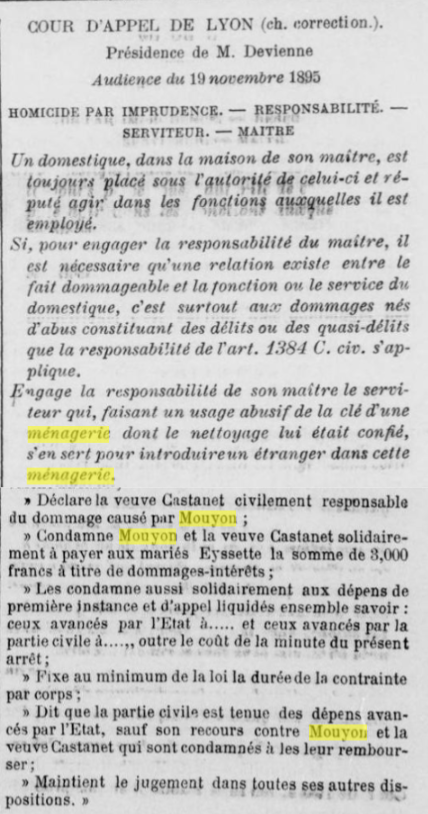
If the excerpt dated 14 September tells the same story except for the role of Mouyon, who seems to have tried in vain to save Eyssette from the lion, the article from 4 February provides new insights. In this second excerpt that I have cut (full link) dated 4 February of the following year, we obtain the following information:
- The hearing took place on 19 November 1895 before the Court of Appeal in Lyon, presided over by Mr. Devienne.
- Mouyon is accused of manslaughter.
- He, along with Mrs. Castanet, the manager of the menagerie, will have to jointly pay 3000 francs in damages to Eyssette's parents.
We note that this article is much more serious as it comes from an editorial line specialised in legal matters and does not seek to distort the truth, hence the usefulness of varying these sources.
In order to conduct a thorough investigation into this event, it seems essential to gather as many articles as possible. This not only allows for the comparison of different versions of the facts and verification of their consistency, but also highlights details such as the address, physical description, or any ancillary mentions that may seem trivial to an ordinary reader, but can prove crucial for a genealogist in search of clues.
In this regard, one might wonder why only three articles from RetroNews report on this matter. However, a simple adjustment of the search criteria can change everything. I remembered that, in the censuses, particularly that of 1886, the surname "Mouyon" could appear under different spellings, such as "Moyon" or even "Mouillon". By conducting the search "Mouillon menagerie", the number of results increases from 3 to 28 articles, all of which report the same event from different angles.
Partial excerpt from the newspaper Le Droit, 4 February 1896, RetroNews

Excerpt from the search "mouillon menagerie", RetroNews
Gallica:
The advanced search function of Gallica is very powerful as it allows for targeting different words based on their proximity. It is also possible to specify the year of publication, the collection, or the author.
For our research, I selected all articles published between 1895 and 1896 that include the words "menagerie" and "mouillon" within 200 words of each other.


63 results are available, which is just over double those offered on RetroNews. However, some of them come directly from the latter (indicated by a RetroNews logo on the right). Furthermore, many articles show very marked similarities, sometimes almost word for word. It can be assumed that at the time, the press releases came from the same agencies, which would explain these resemblances. Nevertheless, it remains relevant to consult all the results in order to adopt a more neutral approach to the narrative and to grasp all the dimensions of the case.
The downside of Gallica is that the number of results is often too large. When searching for a press illustration, for example, it is not possible to select an appropriate category. If one searches for "lion menagerie" in 1895, there are 373 results. And this is where I notice the limitations of the tool's search functionality and that sometimes it is necessary to revert to a simpler search.
Indeed, an additional search via an image engine allows for the identification of an illustration that went unnoticed. If one enters the words "lion 1895 menagerie", we obtain about thirty images, among which one framed in red below catches my attention because it comes from the old press.
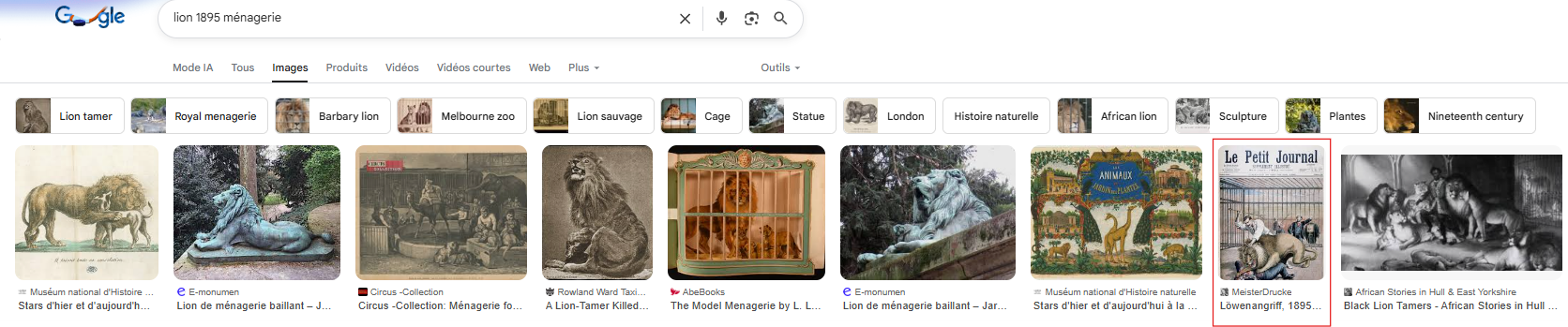
Excerpt from a Google Image search "lion 1895 menagerie"
If we observe the image, we see that it is a title well present on Gallica, but which was not offered to me in the search results. Was I too restrictive in my criteria? In any case, it remains impossible to consult all the results suggested by Gallica. On Google, however, this title appears among the top results.
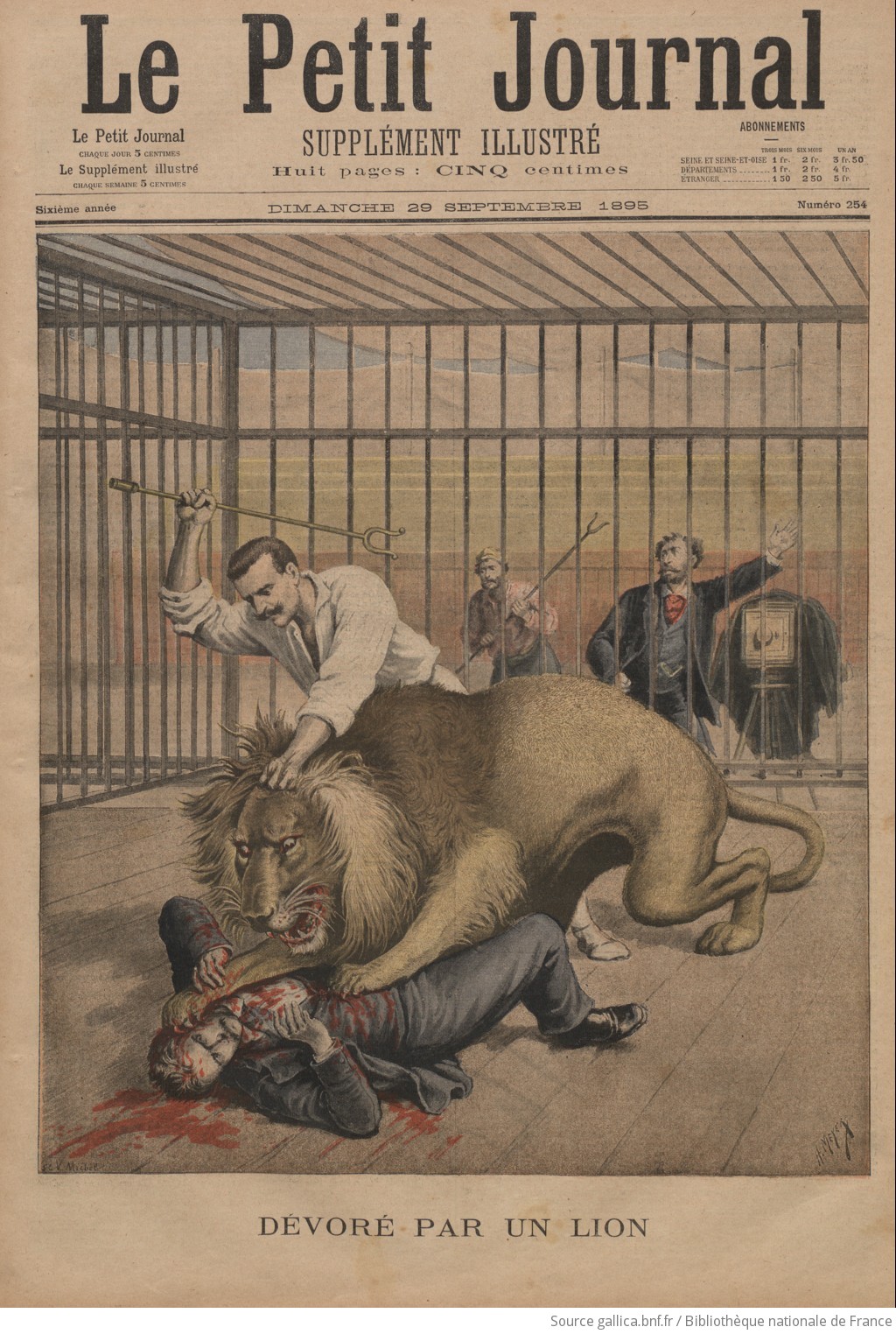
By searching specifically for "Le Petit Journal. Supplément du dimanche" and selecting the date of 29 September 1895 or issue number 254, we finally manage, not without difficulty, to find the illustration created by Henri Meyer, a French caricaturist and illustrator. This illustration features the various protagonists of the story, with what appears to be François Mouyon in the background, alongside the photographer.
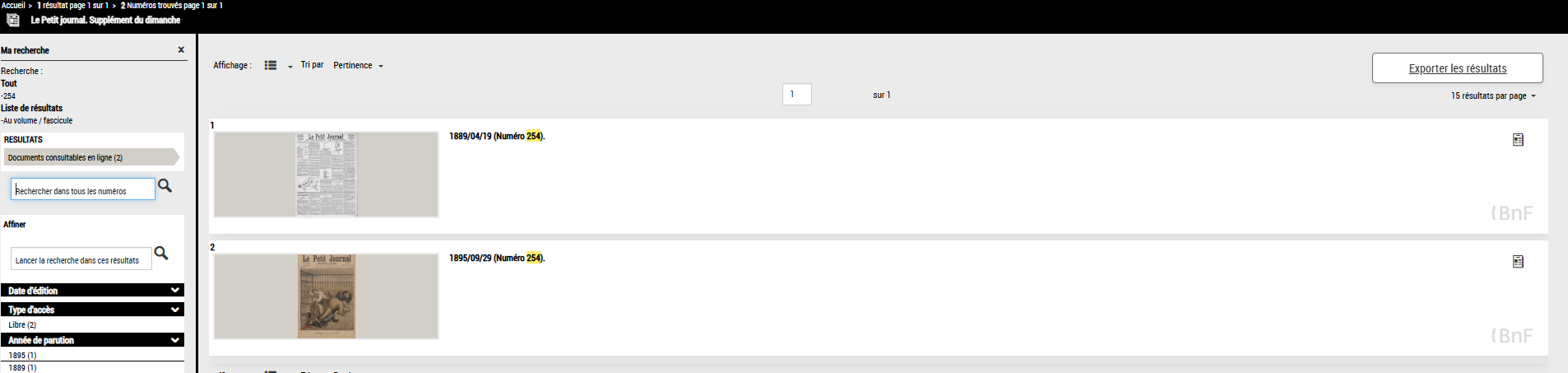
Excerpt from the search "Le Petit Journal. Supplément du dimanche", issue 254
Geneanet:
The process differs slightly from the previous two as it requires entering specific search criteria. The “keyword” category seems too restrictive to me. For example, a search conducted with the term “menagerie” returns no results. It therefore seems more relevant to limit the criteria to the surname, first name, location, and relevant period.

Excerpt from the Geneanet library search
Furthermore, we have noted that the spelling of the name (Mouyon, Mouillon) as well as the first names (Joseph, François) can vary according to the sources. It is therefore advisable to conduct searches without mentioning a first name, at the risk of unnecessarily restricting the results, or to multiply queries by testing the different possible combinations.
Knowing that the affair took place in 1895, it is also relevant to confine the search to the years 1895 and 1896. Indeed, as we have observed, articles relating to this event continued to appear several months after the facts.

What is very useful with Geneanet is that you can add name variants, which we will do here:

However, the name “Mouyon” is indeed associated with “Moyon”, but not with “Mouillon”. However, Geneanet does not allow the addition of this last variant, on the grounds that “Mouillon” already has two alternatives deemed closer. It is therefore necessary to conduct two separate searches in order to cover all spelling possibilities.

The search for "Mouyon" returns 10 results, which is already a good number of results on Geneanet. However, only 1 result is related to our case and we have already consulted it on RetroNews. When we use the name “Mouillon”, we get 112 results, which is not restrictive enough.


Extract from the searches "Mouyon" and "Mouillon", Geneanet
Thus, I recommend adding the first name "Joseph" and then "François" to be more precise and reduce the results. The search with “Mouillon” (and variants) and the first name “François” gives us 0 results, while we obtain 7 with the first name “Joseph”, of which 6 are related to our case.

Extract from the search Mouillon (and variant) Joseph between 1895 and 1896, Geneanet Library
MyHeritage Newspapers:
Without a subscription to MyHeritage, you can conduct the search but cannot click on "View" next to each article. I suggest you search for the newspaper title in another database that contains the article. MyHeritage provides you with the excerpt, the newspaper, the publication date, and you just need to consult the source of the document elsewhere. Similar to how the search works on Geneanet, here is how MyHeritage presents itself in its newspaper collection. It is noted that, despite selecting the first name, last name, publication date, and a keyword, the search does not limit the results to articles that strictly match 100% of the criteria. Instead, it prioritises the relevance of the articles based on the provided elements. Here, the first name "Joséphin" is yet another alternative to those already encountered.

Excerpt from the search "François", "Mouyon", "1895", "menagerie", MyHeritage newspapers
The advantage of MyHeritage is the ability to narrow the search to a specific sub-category of the collection. However, it is not possible to select multiple categories simultaneously. In our case, three categories could prove relevant: “France”, “Names and stories in newspapers”, as well as the section related to OldNews.com and the French Newspapers (which only returns five results). It therefore seems more sensible not to apply a filter by category, but rather to browse the results by identifying titles that have not already been consulted on RetroNews and Geneanet.
The OldNews category, let us remember, corresponds only to a “free” and not updated part of the complete collection available on the OldNews site. There are indeed many duplicates, as shown in the previous screenshot.
Another drawback of the “Newspapers” section of MyHeritage is the inability to select a period covering multiple years: only a specific year can be chosen. Therefore, the search must be repeated for 1895, and then for 1896.
As is often the case, it is advisable to test different filters. Unlike RetroNews or Geneanet, I do not focus here on the total number of results, which is often very high, but prioritise the relevance of the first articles displayed. I am looking for both a diversity of dates and publication titles.
After a few minutes of trials, I finally manage to identify the “winning” combination:

Excerpt from a search (table view) on MyHeritage newspapers, "mouillon", "1895" and "menagerie"
I choose to remain relatively broad by retaining the surname “Mouillon”. However, I restrict the results to only those newspapers mentioning the term “menagerie” at least once, and I also ensure that the publication date falls within the year 1895.
I find that the first thirty-three results obtained do indeed concern the case. However, the subsequent results have no connection to it.
Just like with other press research sites, I compare each title in order to list the new information and the differences with the previously consulted articles.
Conclusion:
This second part, dedicated to the search for articles concerning the drama of the Menagerie, in which my ancestor François Mouyon took part on 12 September 1895, has allowed us to shed more precise light on the chronology as well as the consequences of the events, thanks to the use of the RetroNews, Gallica, Geneanet, and MyHeritage (Newspapers collection) databases.
In athird and final part, we will see how exploring sources that are less abundant in data, but equally qualitative, can prove valuable and allow for the gathering of key information.
Sources:
Cover photo: Le Petit Journal, illustrated supplement, no. 254, Sunday 29 September, Gallica, National Library of France
RetroNews:Search the online press archives of RetroNews
Gallica:Homepage | Gallica
MyHeritage:Newspapers - MyHeritage
Geneanet:Library search
[1]Definition of Menagerie: "A collection of animals of all species gathered for study or public display.", Le Larousse.fr