Have you ever heard an unusual family anecdote about one of your ancestors?
If so, it may be wise to consult period sources to confirm or refute this family story.
How to proceed?
First and foremost, it is essential to establish the genealogy of this ancestor.
Birth, marriage, and death certificates, censuses, military records, notarial acts, land or mortgage documents: any document mentioning a place and a date is worth exploring. These elements allow, as we will see, to reconstruct the context in which this person lived.
Credit: Old illustration of a domestic scene - royalty-free, ilbusca, istockphoto
In this first part of a series of three articles dedicated to researching a family legend in the old press, I will present the method to follow to prepare your investigation, based on a family event.
Tracing a family legend, between genealogical research and exploration of the press
Step 1: identify all the elements of the family anecdote
If this story was passed on to you by someone still alive, it is important to gather as much information as possible, even recording their testimony, like a journalist.
This may seem obvious, but some key elements are essential to know:
The people involved in the story
The period: decade, year, month, or season
The location: from the country to the department, then to the city and even the street if possible
The consequences of the story: any element that may have been mentioned in an official document
The details of the anecdote
When I was younger, my great-grandmother, who was already approaching a hundred at the time, told me that her father had had problems with the law in his youth. From what I remembered (very little as I was not even ten at the time), he had a sordid story when he worked in a zoo. He allegedly poorly supervised a lion's cage, and someone became a victim. Subsequently, he was said to have been sentenced to prison.
As we can see, I had very few details at this level, so I asked my mother since, in general, the details of a story are clearer when the generational gap with the individual concerned is small.
My mother confirmed the story, adding some crucial elements:
He lived in Lyon at that time
It was not a zoo but a menagerie; the difference is that a menagerie has a commercial rather than scientific purpose. The animals are presented in the form of a travelling show. The menagerie has a private status like at a fairground[1].
Step 2: trace the genealogy of ancestors
It is not essential, as it is quite possible to conduct research in the press without having these documents. However, understanding the context in which our ancestors lived, as well as the specifics of their time, allows for more targeted and effective research. Genealogical research sometimes provides the keys to unlock certain leads.
I therefore classify the importance of documents into two categories:
Important:
Birth, marriage and death certificates (and those of the partner and children)
Census records, military service records
These documents are both the gateway to basic information about your ancestors, namely when and where they lived, but also very useful for locating a person at a specific moment in time, which will be of interest to us for investigation.
Bonus:
Various notarial acts (marriage contract, will, receipts, leases)
Land registry and mortgage
Sometimes more complex to find, these documents also allow us to know where an ancestor lived and what they were doing at that time, as well as their connection to a person who may not be mentioned in the civil status records.
Genealogical research

Postcard Montélimar, Place du Marché, F. Baume Bookstore, Geneanet
Son of a travelling merchant and a housewife, he became an orphan at the age of 7. He is the youngest by two years after losing his fifteen-month-old little brother in 1877.[3].
With his brother Julien Marius, they went to live with their grandparents Joseph Vincent Berard and Marie Marguerite Constantin, still in Montélimar. His grandfather, a wool comb and carder, and his grandmother, the daughter of a miller, probably have something to do with the manual skills of their grandchildren since Julien Marius would become a mason and François would hold various positions, the main one being a plaster painter.
In the population censuses of 1876, 1881, and 1886, we find him in Montélimar.[4]. In these, we note that he is named “Joseph” and also “Moyon” or “Mouillon”. Joseph was certainly his common name and François the administrative name. These details will be important later.

Extract from the 1886 population census, 2 Mi 911/R5, view 214/663

Extract from the military register of François Mouyon, 1 R 157
We then lose track of him until he turns 20 in 1892, the legal age for military service. I will not provide a precise summary of his military register, but it allows us to obtain his successive addresses.
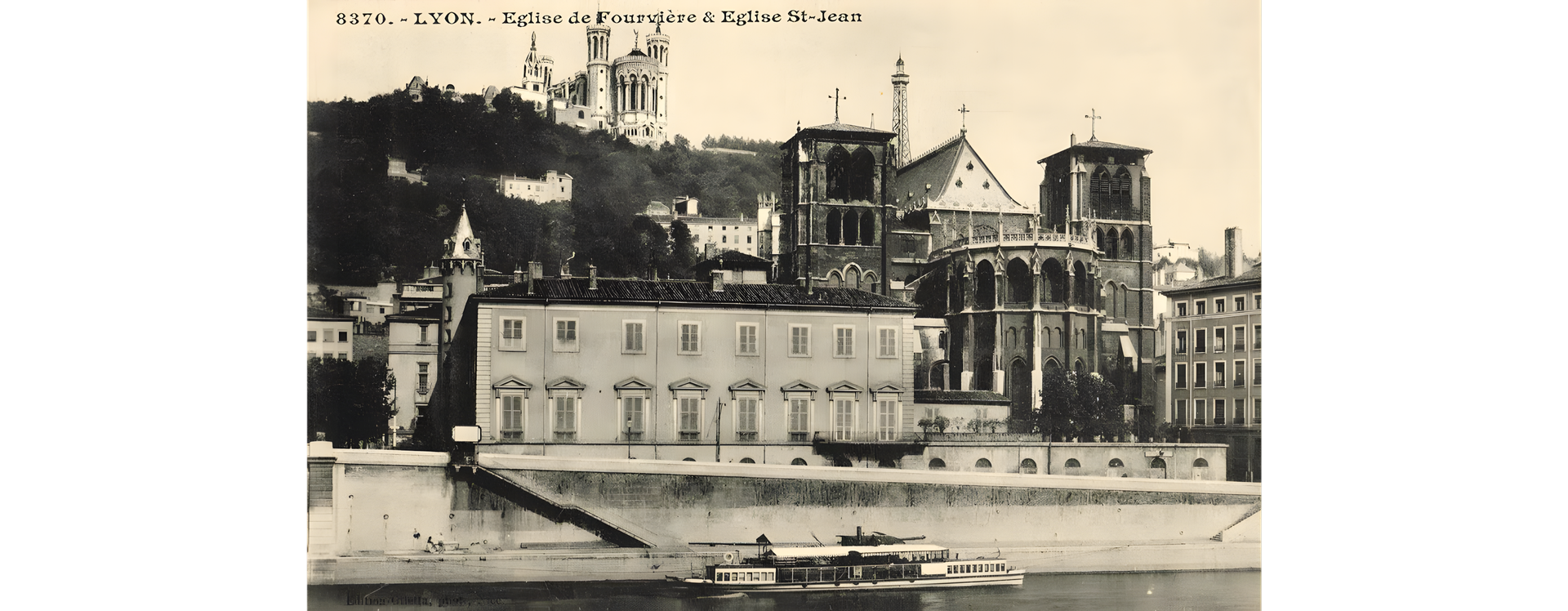
Archives of the Rhône department, Lyon. Church of Fourvière and Saint-Jean church, 11Fi1568
In this extract, we see that he lived in Lyon for a long time, which supports the family anecdote.
He served during the First World War from 1 August 1914 to 30 September 1914 and then from 11 October 1914 to 1 January 1919.
His romantic life, as revealed by the archives, was marked by great instability:
He attempts to marry Benoîte Eléonore Subtil. Two marriage banns are published on 29 November and then on 5 December 1896, but the marriage will not take place. What are the reasons? Could it be the pressure from the in-laws? At that time, they live together in Lyon, 36 Montesquieu Street. They will have a child: Joseph Mouyon in Lyon on 24 June 1898. He will not be officially recognised by François until 25/04/1905.[5].
On 24/11/1904, he marries Jeanne Jarrier in Lyon.[6]. They will have a daughter, Emilie.
On 15/03/1913, he marries Herminie Maria Berthod in Lyon.[7]. Together, they will have Louise and Lucienne.
During the numerous censuses and civil status records, here are the professions held by François:
Plaster painter
Mason
Glue merchant
Drugstore owner
Brush maker
Machinist
In view of the numerous professions he practiced throughout his life, I checked if there was a career file in his name on the website of the Lyon Municipal Archives. Indeed, there was. This file, consisting of five pages, indicates that he was a machinist at the Grand Théâtre de Lyon from 15 September 1907 to 12 April 1908.
He therefore held a technician position responsible for the installation and arrangement of the sets. This document mentions the first names "François" and "Joseph" from one document to another.
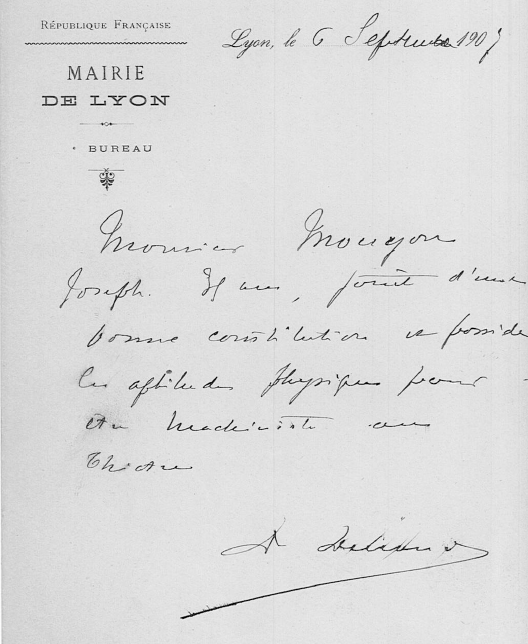
Transcription:
"Lyon, 6 September 1907,
Mr. Mouyon
Joseph, 35 years old, enjoys a
good constitution and possesses
the physical abilities for
to be machinists
at the theatre."
Extract from the career file of François Mouyon, AM Lyon, 524W_703
In view of the numerous jobs he held throughout his life, I checked if there was a career file in his name on the website of the Lyon Municipal Archives. Indeed, there was. This file to your left consists of five pages and indicates that he was a machinist at the Grand Théâtre de Lyon from 15 September 1907 to 12 April 1908.
He therefore held a technician position responsible for the installation and arrangement of the sets. This document mentions the first names "François" and "Joseph" from one document to another.
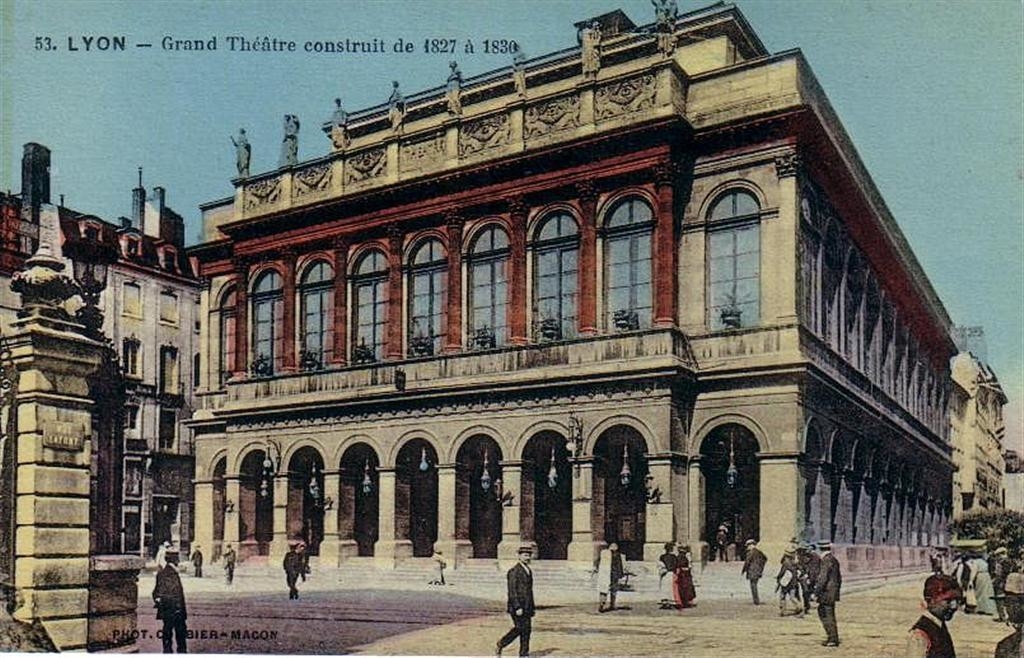
Postcard of the Grand Théâtre de Lyon, Place de la Comédie, photograph by Corbier - Macon, Geneanet
Research in the population censuses shows that he remained in Lyon until the end of his life. He passed away at his son-in-law's home in Pressiat in the Ain on 17 March 1944.[8].
Step 3: research in the old press
This is the step that will allow us to gather information related to the family history.
To do this, we can turn to these main sites, even though there are indeed many other sources at the local level.
RetroNews:website of the National Library of France (BnF), free for simple searches but partially paid for the advanced search engine. It focuses on the old press. Some newspapers available on Gallica are not available on RetroNews and vice versa. However, there are many more newspapers on RetroNews (over 2000 titles) than on Gallica (over 200 titles).
Gallica:the website of the digital library of the BnF and its partners. Free. Ten million documents including books, journals, newspapers, scores, prints, maps, photographs, audio recordings.
OldNews :built by MyHeritage, it contains 423,075,311 pages and 41,524 titles. Requires a paid subscription other than that of MyHeritage.
Geneanet :Thirteen million documents of old press, 19,415 press titles.[10], simple free search.
MyHeritage newspapers :half the content of Old News, newspaper updates are less frequent.[9]. Subscription required to access research articles.
BelgicaPress:created by the Royal Library of Belgium. Specialised in Belgian press, free with over 120 accessible titles, more than four million digital documents. Account creation required.
Lectura Plus :+ over 500,000 pages of regional press in Rhône-Alpes.
Numelyo :The digital library of Lyon has a very rich collectionwith numerous posters, manuscripts, photographs and Lyonnaise press from 1790 to 1944 comprising about 270 press titles.[11].
Across all platforms, the OCR process is used which also allows searches in digitised documents using text and word recognition.
Step 4: cross-reference information and explore new sources.
Why is cross-referencing sources essential?
Newspapers are full of valuable information, but this is not always completely accurate or perfectly precise. Facts can be distorted and some elements exaggerated. It therefore seems essential to confront the same story through different titles and editorial lines. It is also relevant, based on the information gathered from the press, to explore other resources held in departmental, municipal, or local archives, as well as in museums or local history societies.
To be concise and methodical, I recommend using a simple Excel file to list all articles by their title, publication date, link, acquired information, and avenues to explore.

Example of an Excel "summary" file to list newspaper titles.
Conclusion:
In this article, we presented the four steps to verify a family legend using old press: listing the elements of the anecdote, reconstructing the genealogy, searching in the press, and then cross-referencing the information with other sources.
In a second part, I will show you concretely how I managed to trace and verify this family anecdote using the research tools available in the old press with RetroNews, Gallica, Geneanet, MyHeritage and in a third part, the investigation will continue by calling on new sources, such as BelgicaPress, Lectura Plus and Numelyo, which are more specialised and offer yet unexplored titles. I will also emphasise the importance of synthesising information, as well as the tools that enable its construction, in order to facilitate the opening of new documentary avenues.
Sources:
Cover photo: Front cover, Le Progrès Illustré, No. 249,Numelyo
[1]History of the Menagerie,Jardin des Plantes, Paris
[2]Birth certificate of François Mouyon, 1872, Montélimar, 2 Mi 911/R5, view 214/663,Departmental Archives of Drôme
[3]Death certificate of Régis Mouyon, 1877, Montélimar, 2 Mi 911/R6, No. 193,AD26.
[4]Population censuses,AD26, 1 Num 883, view 262/357,AD26, 1881, 6 M 346, view 242/461,AD26, 18861 Num 883, view 43/415
[5]Birth certificate of Joseph Mouyon,Municipal Archives Lyon, 2nd, 2E1778, view 194/201
[6]Marriage certificate of François Mouyon and Jeanne Jarrier,AM Lyon, 6th Arrondissement, view 335/398
[7]Marriage certificate of François Mouyon and Herminie Maria Berthod,AM Lyon, 1st arrondissement, 2E2124 - 55, view 55/151
[8]Death certificate of François Mouyon,Pressiat Town Hall, no. 1.
[9]MyHeritage Launches OldNews.com: A New Website for Exploring Historical Newspapers,Geneamusings.com
[10]Are you making good use of the Geneanet Library, Frédéric Thébault,Geneanet.org