
How can I find out if my ancestor was considered an emigrant during the French Revolution?
Between 1789 and the beginning of the 19th century, around 150,000 people left France or were considered "emigrants" by the revolutionary administration. For a genealogist, knowing whether an ancestor held this status helps to understand the confiscation of their property, their movements, and sometimes family conflicts.
1. What does "émigré" mean during the revolutionary period?
The term does not only refer to someone who has physically left the territory. Anyone registered on the official lists of emigrants is considered an emigrant, lists which lead to the confiscation of property and sometimes the death penalty in the event of return.[1]
- There are nobles, priests, officers, but also bourgeois or artisans absent from their homes for private or professional reasons, or even individuals who are victims of denunciations or mistakes.
- From 1796 onwards, numerous amnesty laws and procedures for reinstatement allow for the return and partial recovery of property, provided that one can prove their presence or loyalty.
--> In total, the National Archives hold 41,600 applications for removal (F/7), concerning approximately 44,000 individuals from the official lists of emigrants[2] (44,618 lines in the Excel file mentioned below).
--> More than 8,600 files (concerning approximately 10,500 individuals) have been digitised and are accessible online; some files are particularly large (over 50 pages) and represent rich historical sources to be explored. Notably, there are at least 7,500 women included.
2. Does the term "emigrant" appear in the civil status records?
In the vast majority of cases, the concept of emigrant does not appear directly in the civil status records (baptisms, marriages, deaths, and then civil acts after 1792).
- The acts may however contain clues:
- mention of a death "abroad"
- spouse "absent for several years"
- widow who remarries while her husband is presumed missing
- It is mainly the notarial acts and administrative documents that refer to emigrants, those warned about emigration, removal from lists, etc.
Before exploring the sources related to emigration, I recommend tracing the birth, marriage, and death of the individual as well as those of their relatives to gain context.
3. How can I know if my ancestor became an emigrant?
In two steps, it is easy to obtain information about an ancestor or an emigrated individual. For this, several databases and manipulations are necessary.
--> Step 1: check the lists of individuals declared as emigrants during the French Revolution.
- Question the base on the site data.gouv.fr in the file CSV “Individuals presumed to have emigrated during the French Revolution” by surname, first name, and current department (including former departments now in Belgium, Luxembourg, Switzerland).
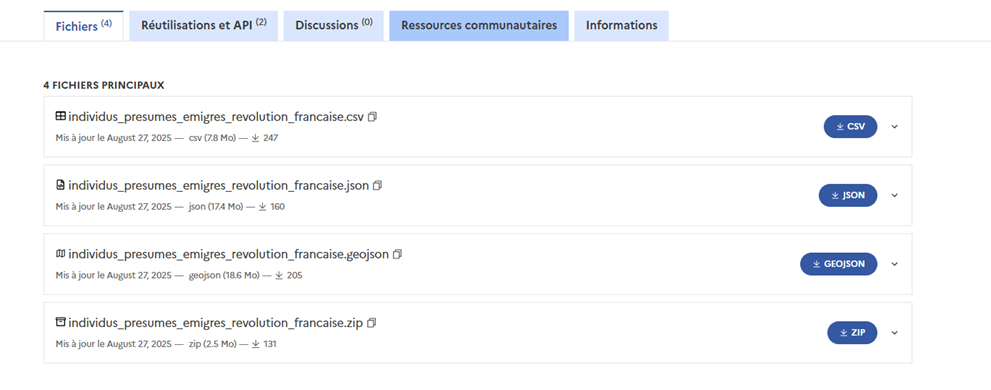
Excerpt from the article Individuals Presumed to Have Emigrated During the French Revolution (1791-1815), data.gouv.fr
- If the ancestor sought appears, the notice refers to a reference number and often to a digitised file containing: certificates of residence, passports, notarial acts, testimonies, correspondence, decisions of removal, etc.
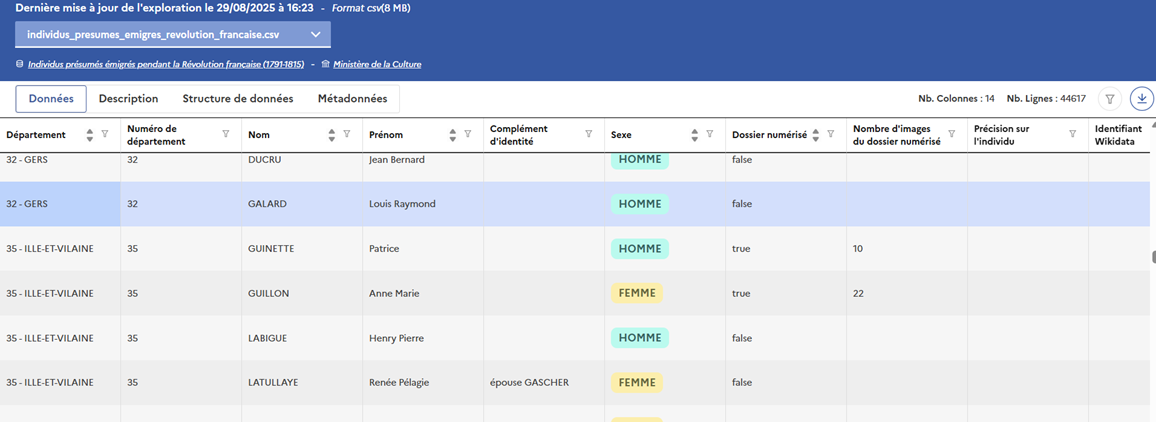
Example of presumed emigrant individuals, Ministry of Culture, browser format, data.gouv.fr
This dataset is also accessible via Excel. Personally, I prefer to use Excel because it allows for easier interaction with the database and more information is visible on the screen at once.
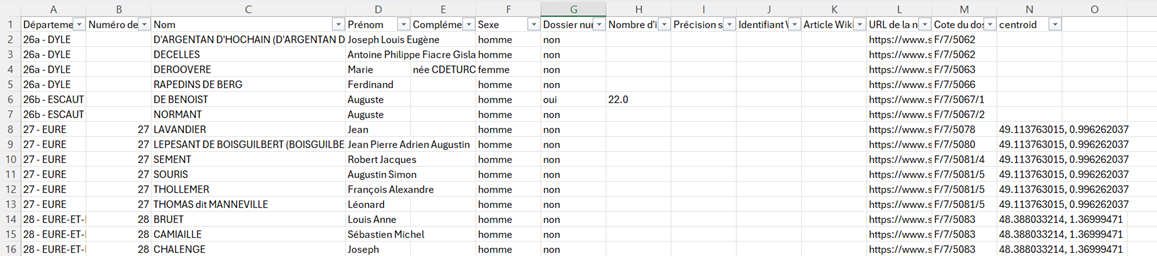
Example of presumed emigrant individuals, Ministry of Culture, CSV format, data.gouv.fr
--> Step 2: consult the file of personal records for requests for cancellation and release of seizure
From 1796 onwards, the Directory and then the Consulate opted for less repressive legislation, which allowed the return of emigrants on the condition that they obtained their removal from the lists of emigrants, followed by amnesty laws (1799 and 1802). Some emigrants, for private or professional reasons, were declared emigrants because they were absent from their homes.
The National Archives have digitised approximately 20% of the files[3] (8,600 out of the 41,600 files). These files are those seen in step 1, in column L of the Excel table and are accessible via the following links depending on the departments:
Attention, some departments no longer exist today, so it is important to check that the department had the same name at the time. Here is the list of the former French departments.
The URL you see in column L of the Excel file refers to the named folder.
These pieces generally allow for dating:
- The period during which he is deemed to be an emigrant (registration on the list)
- The efforts of his family or himself to demonstrate that he has not emigrated or that he has returned
- The date of removal or amnesty (laws of 1799, 1800, 1802)
4. How can I know when my ancestor is no longer an emigrant?
You can consult the emigrants' file online to obtain the reference and, if applicable, the date of removal from the list.
This supplementary file (AB/L/1500) contains 71 boxes and brings together over 100,000 records. It indicates the final dates of removal pronounced by the Ministry of Police for the emigrants of Year II-1810.
These files are available for consultation at reference AB/L/1500/1-AB/L/1500/71 on the site of the national archives and on-site for non-digitised files.
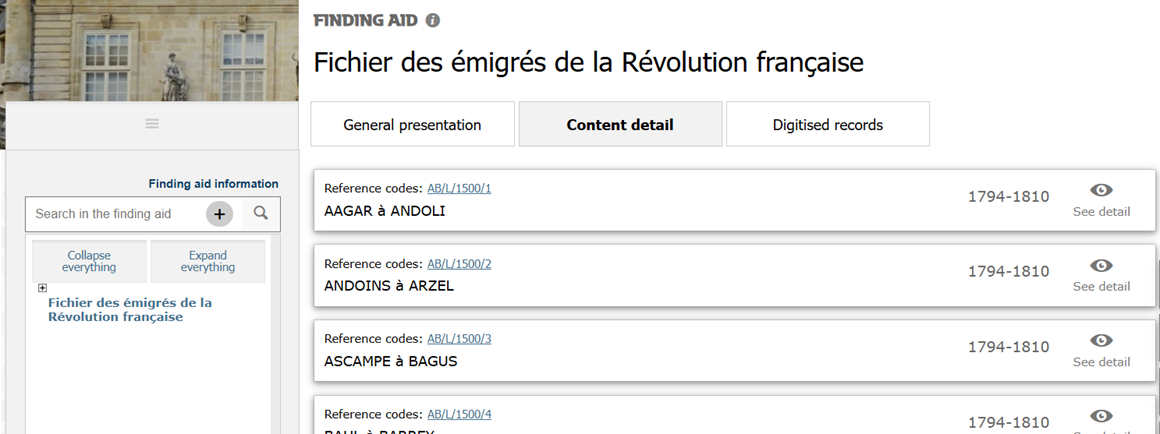
Extract from the file of emigrants of the French Revolution, SIV, National Archives
5. Explore the local archives
It is always useful to complement this research with local archives to clarify the chronology; we can cross-reference with:
- The municipal registers and district/department deliberations.
- The sales of national property (property of emigrants), auction registers and the first cadastral matrices.
- Notarial acts: inventories after death, sales, divisions, marriage contracts mentioning an "emigrant" or an absentee.
This intersection allows us to understand the consequences of emigration for the individual and their family.
6. Specificities between France and Belgium
During the revolutionary period, part of present-day Belgium was annexed and transformed into French departments (Dyle, Jemmapes, Ourthe, etc.).
The inhabitants of these territories may also appear in the lists of emigrants preserved in the National Archives; the databases of individuals presumed to have emigrated explicitly cover these former departments that are now Belgian or Luxembourgish.
The main difference for the genealogist is that in present-day France, it is necessary to combine the National Archives and the French departmental archives, whereas for ancestors from the annexed Belgian provinces, it is relevant to add the Belgian archives (civil status, notaries, national property funds) to track the sale of properties and the situation after 1814.
7. A concrete case, the example of a genealogical research of a person listed as an emigrant
In a previous articleI was explaining the mechanics of the sale of a national asset by taking the example of a house sold during the French Revolution to a buyer named Jean Claude Meynier.
This house, before being sold, was seized from an emigrant named Louise de Faucigny Lucinge, wife of Louis Gaspard de Seyturier. I suggest you discover how to find information about her emigration. Series Q of the departmental archives allows access to the list of properties and estates seized from emigrants during this period. Seeing her emigrant ancestor on this list can already serve as verifiable evidence on the national lists.

Departmental Archives of Ain, registers of confiscated property during the revolution, property of emigrants (2nd origin), series Q, number 14, view 2/403.
In order to obtain complete information about Louise de Faucigny Lucinge, it is relevant to construct a family tree that includes at least her parents, siblings, and sisters.
Indeed, before starting a search for emigrants in lists containing names and surnames and to avoid errors, it is preferable to have all the information at hand.
This preliminary research is primarily conducted through baptism, marriage, or death records but can also include marriage contracts, wills, etc. In our case, it is carried out almost entirely at the departmental archives of Ain but also in Savoie (death of Charles Louis Amédée), Paris (death of Louis Gaspard de Seyturier), Haute-Savoie (birth of Josephte Antoinette), and the Canton of Vaud (death of Eléonore Charlotte).
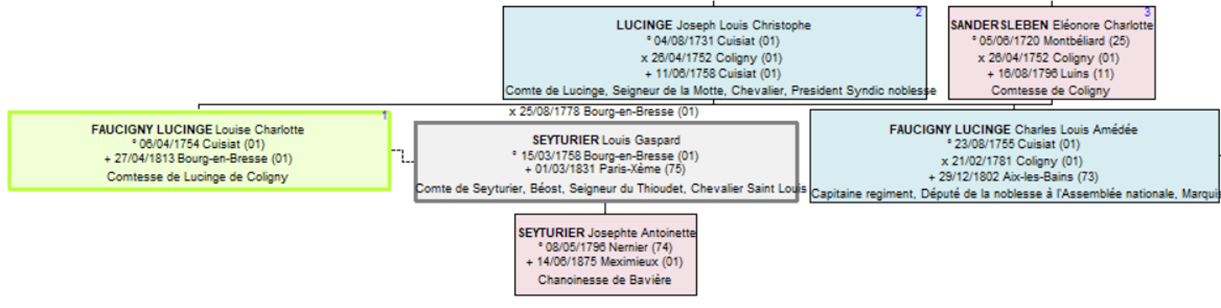
Family tree of Louise Charlotte de Faucigny Lucinge, Généatique export 2024, model 2023-ac-complete, version 1.3.5.
--> Step 1: confirm that Louise Charlotte Faucigny Lucinge is indeed present in the lists of emigrants.
On the CSV file or directly on the database data.gouv, it is possible to check if a person has been considered as emigrated by entering their name, and to find out if their individual file for the request for removal and release from sequestration is digitised, as well as their exact rating.
By querying the file of individuals presumed to have emigrated on data.gouv.fr, the search for "Seyturier" reveals Marie Alexandre and Louis Gaspard de Seyturier.
This latter being the husband of Louise Charlotte de Faucigny Lucinge, it is possible that information concerning her is included in her husband's file.
However, each emigrant is the subject of a distinct named entry in the list; if Louise Charlotte had been registered under her husband's name, an additional line would therefore need to appear, which is not the case here.

Extract from the file of individuals presumed to have emigrated, Seyturier, National Archives.
On the other hand, if we enter the name Faucigny, we also find a "Sendersleben de Lucinge Louise Charlotte".

Extract from the file of individuals presumed to have emigrated, Sendersleben de Lucinge, National Archives.
Thanks to the tree we previously illustrated, we confirm that Charlotte Sandersleben is indeed the mother of Louise Charlotte Faucigny Lucinge and that she has also been considered an emigrant. They are also likely registered in the same file.
His father Joseph Louis Christophe passed away long before this period, which explains why he is not registered.
--> Step 2: consult the personal file for the application for removal and release of the seizure
As mentioned in the orientation sheet of the National Archives. "The sub-series F/7 retains the so-called 'departmental' series [F/7/4826 to 5789/2] of individual files of requests for removal and lifting of sequestration from the Emigrants' Office of the Ministry of the Interior. Transferred by the General Police Directorate of the Ministry of the Interior in 1842, this series consists of 1152 items classified by department, then in alphabetical order of surnames."
Let's now consult the file with reference F/7/4835/2. Two options: search for "Lucinge" or paste the URL directly: Intérieur ; Police générale. Émigrés de la Révolution française : dossiers nominatifs de demandes de radiation et de main-levée de séquestre (Révolution et Premier Empire).
In this one, we have two options. Either enter the name Lucinge in the search, or we can directly copy and paste the URL address from the notice given in the Excel file:
Thus, we notice that the files of Charlotte and Louise Charlotte are in the same folder, which is number 313.
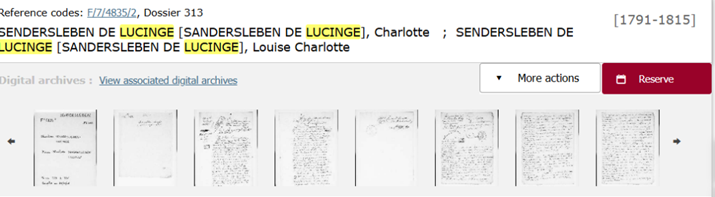
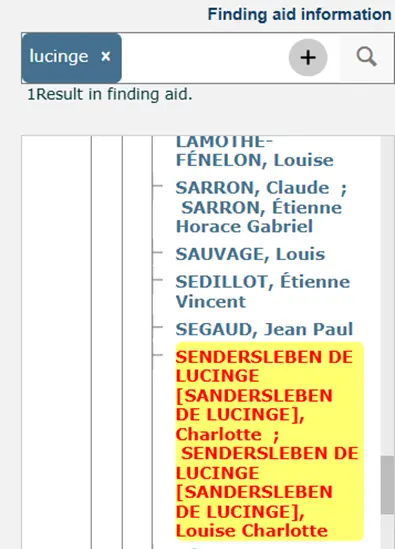
Interior. Emigrés of the French Revolution: nominative files of requests for removal and lifting of seizure (Ain to Eure-et-Loir), File 313, Reference codes: F/7/4835/2, SIV, National Archives.
File analysis:
The 12-page file helps us to understand:
- The causes of their emigrations:
Indeed, from the decree of 27 November 1792, the annexation of Savoy is declared, which is attached to France.[4]It is during this same year that Louise Charlotte and her mother will be considered émigrés due to an alleged journey on 9 July 1791 to Chambéry, which was at that time in Savoy, the Kingdom of Sardinia.
- The initial arguments for requesting to leave the country:
It is stipulated that Charlotte Sendersleben Lucinge and her daughter Louise Charlotte Sendersleben Lucinge have submitted a passport application to travel to Aix, a request validated by the municipality and the directory of Bourg, accompanied by a certificate from a health officer in Bourg on 6 July 1791. The reasons for this trip are for Louise Charlotte to undergo the treatment of the "waters," that is, a spa treatment at the baths of Aix, as she was in a "state of decline."
- The counterarguments regarding their status as emigrants:
They would have stayed in Aix for a long time because of "the difficulty of passages". They would have stopped in Chambéry according to the certificate dated 5 April 1792 to consult a doctor, Mr Lyonne, who instead of advising them to use the waters of Aix, had them administered other remedies such as going to the Waters of La Boisse and not Aix.
This dispute is accompanied by the doctor's certificate from Chambéry dated 5 April 1792.
- The stakes of the demand:
The sale of a property located in Cuisiat belonging to Dame Sendersleben through the notary Mr. Fontaine on 24 December 1791 for the sum of 18,000 livres, which remained in his hands to be held until 16 March 1792. Thus, in accordance with the decree concerning the law of emigrants of 12 February 1792, which involves returning the property of emigrants to the nation, the notary used this pretext to withhold the deposit of 18,000 livres. He also "regarded the claimants as emigrants" and told them that "the decree tied their hands," after which the two women issued a summons to compel him to return the deposit, but the notary requested permission from the departmental directory.
The two women then submitted their request to recover this sum on 30 March 1792.
They believe that the decree does not deprive them of their money and they declare "that they have never had the intention of emigrating and that if they went to Chambéry, they only went there for absolutely necessary and indispensable reasons."
They support the fact that the documents and evidence attached to the file leave no room for doubt and that the case of the decree does not yet allow for the seizure of their assets because there is normally a time limit and they returned to France in time before the expiration of this limit. However, they do not mention the duration of this limit, which weakens this argument.
What may be surprising is that in the ladies' request, they do not even seek to have their status as emigrants revoked, but instead focus all their arguments on the restitution of the sum of 18,000 pounds. It appears that they do not feel at all concerned about their status.
- The opinion of the directory regarding this request issued on 16 April 1792:
In this request, the applicants are seeking their removal from the list of emigrants, attaching a medical certificate stating that Louise Charlotte was to undergo a treatment, including baths in the lake and the thermal baths of Aix, prescribed due to her state of decline. The ladies would have gone to Chambéry and not to Aix as stated in their application. Furthermore, they would have returned to France either to Lyon or to Bourg to sell an estate on 24 December 1791 before the notary Mr. Fontaine. After this time, the Directory considers that the medical excuse was no longer valid and that the passport authorisations and the consent for travel were worthless. It is therefore their second absence from the country that is detrimental in this matter and can only be regarded as emigration.
- The consequences of his emigration
· The loss of the sum of 18,000 pounds from the sale of an estate remains in the hands of the nation.
· The new status of emigrant.
· The seizure of all their assets (including the house which will be sold on the 21st of Frimaire in the Year II (11th December 1793).
- His relationships with his mother and his wife
We learn that Louise Charlotte de Faucigny Lucinge was at the time of the request for "separation of property" from her husband Louis Gaspard de Seyturier. The reasons for this are not known from this document. It is also certain that Charlotte Eleonore Sendersleben and Louise Charlotte Faucigny Lucinge were very close as they emigrated together and are part of the same radiation file.
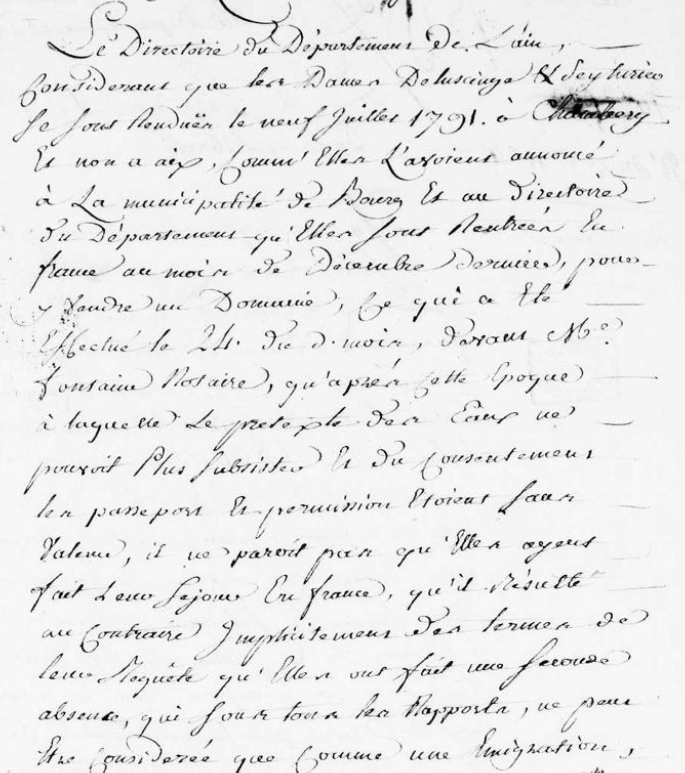
Transcription :
« Le directoire du département de l’ain,
considérant que les dames De Luscinge et Seyturier
se sont rendues le neuf juillet 1791 à Chambery
et non à Aix, comme elles l’avoient annoncé
à la municipalité de Bourg et au directoire
du département qu’elles sont rentrées en
France au mois de décembre dernier pour
y vendre un domaine, ce qui a été
effectué le 24 du dit mois, devant Me
Fontaine, notaire, qu’après cette époque
à laquelle le prétexte des eaux ne
pouvoit plus subsister et du consentement,
les passeport et permission etoient sans
valeurs, il ne paroit pas qu’elles ayent
fait leur sejour en France, qu’il résulte
au contraire implicitement des termes de
leur requête qu’elles ont fait une seconde
absence, qui sous tous les rapports, ne peut
être considerée que comme une émigration. »
Extract from the personal file of requests for removal and lifting of seizure (Ain to Eure-et-Loir), Sendersleben, File 313, Reference codes: F/7/4835/2, SIV, National Archives, page 1 and 4.
--> Step 3: consult the file of emigrants online and then in person in Pierrefitte-sur-Seine to obtain the date of deregistration.
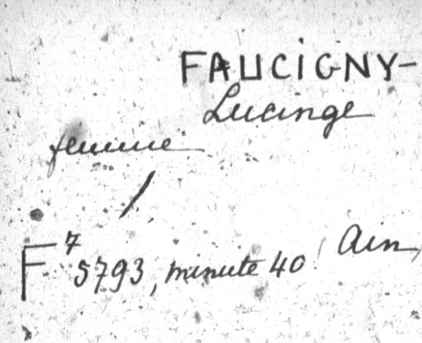
In the document, the term "emigrant" appears for "Lucinge wife Seyturier". If we check the emigrants' file, we find that she is indeed present. The reference for the list "F7 5793" should be requested and consulted on-site in Pierrefitte-sur-Seine. In reality, it does not contain much information apart from the time when the Ministry of Police permanently removed her from the list of emigrants.
File of emigrants from the French Revolution, Faucigny Lucinge, AB/L/1500/30, view 795/1000.
In the emigrants' file, she is struck off the list of emigrants on the 28th of Vendémiaire in the year IX (20th October 1800).
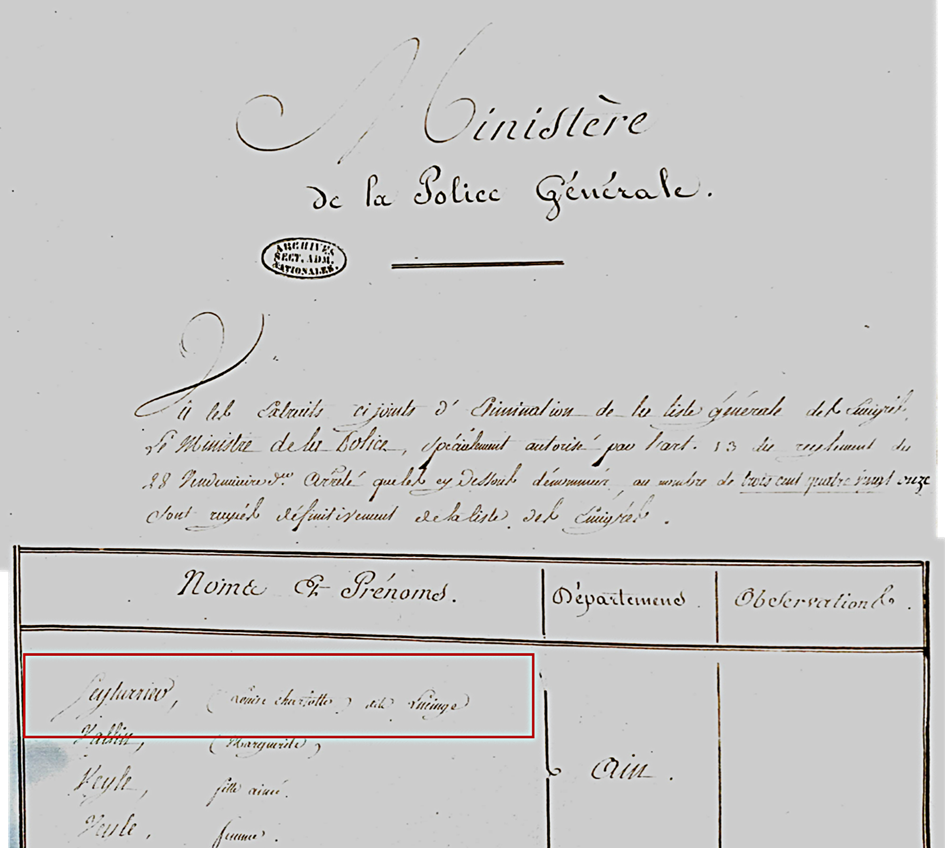
File of emigrants, F/7/5793, 28 Vendémiaire Year IX, 20 October 1800, National Archives, Pierrefitte-sur-Seine.
--> Step 4: explore the local archives
We can combine this research with the local archives that may hold other information.
By contacting the Departmental Archives of Ain regarding the sale of a national asset belonging to the émigré Louise Charlotte Lucinge, wife of Seyturier, we obtain an inventory file of nearly one hundred pages containing multiple pieces of information about the sale of the house as well as about its owner during the French Revolution. For example, here is the prefectural order from the department of Ain dated 6 Messidor Year IX (25 June 1801), which is eight months after the national order from the Ministry of Police. We therefore note that the cancellation was not immediate, taking time to be reflected at the prefectural level, and that she received no compensation for the assets alienated by the nation.
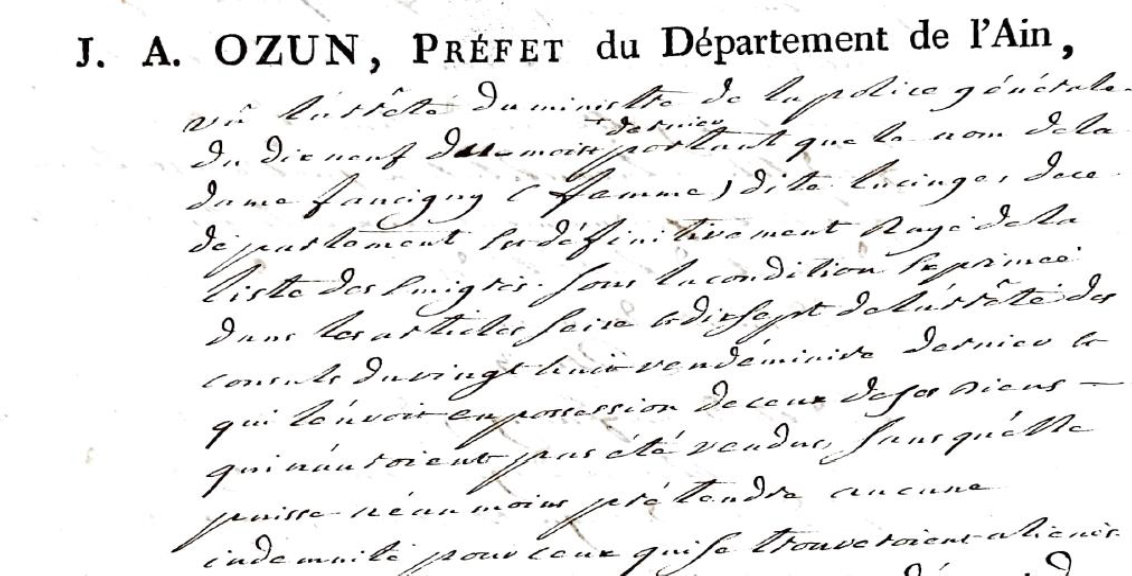
Prefectural order of 6 Messidor Year Nine concerning the removal of emigrants, Inventory, AD01, D2-246, view 83/93.
The memoirs of learned societies, such as the Éduenne Society, also provide information on emigration, even when their publications appear more than a century after the events.
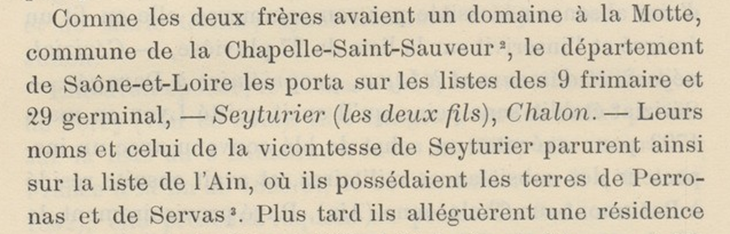
Excerpt from the Memoirs of the Éduenne Society, Éduenne Society, January 1931, page 38.
Conclusion
The term "emigrant" does not appear in civil status records, but it can be found in official notarial acts, local archive files, the press, and the memoirs of learned societies of the time.
To confirm the presence of an emigrant in the official lists, consult the database of individuals presumed to have emigratedIf a file exists, the nominative file for the request for removal and lifting of the seizure, available when digitised on the SIV of the National Archives, details the reasons for emigration, the grounds for contestation, and the request for removal.
It is also useful to consult the file of emigrants online or on-site in Pierrefitte-sur-Seine to obtain the exact date of removal.
Finally, explore local sources: registers of seizures/attachments, minutes of sales, restitution files, municipal deliberations, notarial deeds, and judicial matters in the departmental and municipal archives.
These archives related to emigration are a goldmine for reconstructing family biographies, with details about daily life, medical treatments, and economic conditions. In the case of Louise Charlotte de Faucigny Lucinge, the sequestration file reveals her life before and during the Revolution, including medical reports and expenses recorded under the supervision of the Directory.
A forthcoming article will detail a sequestration file, that of Louise Charlotte de Faucigny Lucinge, to illustrate how to exploit this biographical source.
Sources :
Photo de couverture : Le casino d’Aix-les-Bains, façade ouest sur jardin, in Amédée Achard, Une saison à Aix-les-Bains, 1850, vue 124/396, Gallica.
[1] France. Bureau des émigrés (1792-1805), France archives
[2] Individus présumés émigrés pendant la Révolution française (1791-1815), article écrit le 29 avril 2024, data.gouv.fr.
[3] Ministère de la culture, data.gouv.fr, 2024
[4] Digithèque, réunion de la Savoie à la France en 1792, 2004, mjp.univ-perp.fr, consulté le 12 octobre 2024.