
How to find a Chanoinesse ancestor? Start with the genealogical trail
In this article, we will investigate the lives of two canonesses, direct descendants of the Seyturier and Faucigny Lucinge families, whose emigration we have identified. in another article.
While her parents were still considered émigrés from the nation, leading to the seizure of their property. It was on 8 May 1796 that Josephte Antoinette de Seyturier was born in Nernier, in Haute-Savoie.[1], in the province of Chablais.
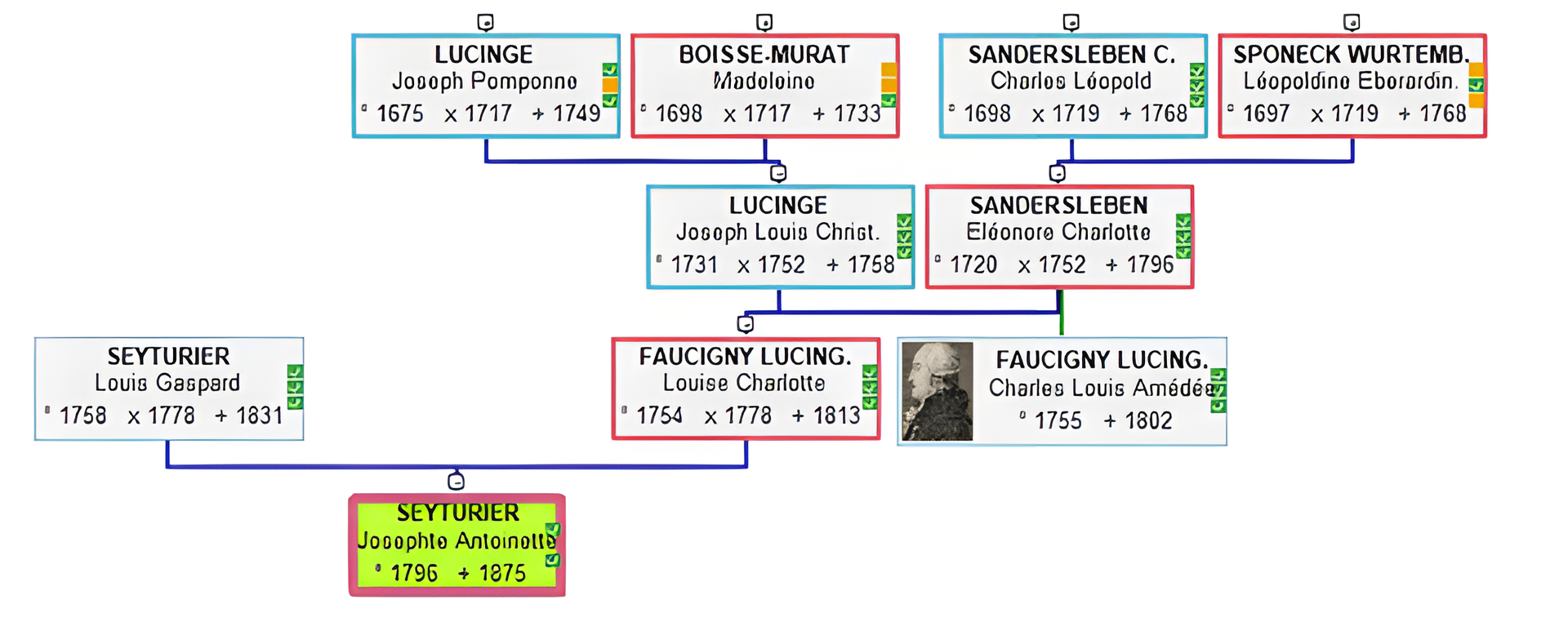
Family tree of Louise Charlotte de Faucigny Lucinge, Généatique export 2024, model 2023-ac-complete, version 1.3.5.
Religion, a family affair?
If his father Louis Gaspard is destined for a military career[2] As an officer in the Crown Regiment, his mother, Louise Charlotte, was sent in her youth to the nuns as a canoness at the chapter of Neuville-les-Dames. Indeed, in 1757, a year before the death of her father Joseph Louis Christophe de Lucinge, she received a certificate of canoness and the title of countess of the chapter of Neuville from Cardinal de Tencin, archbishop and count of Lyon.[3].
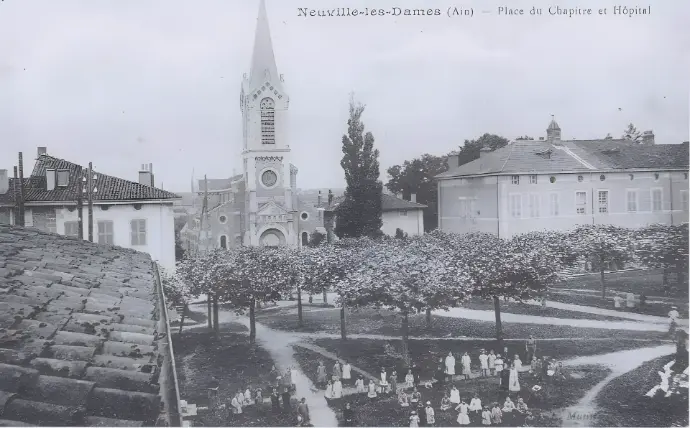
Postcard of the Chapter Square and the Neuville Hospital, patrimoines.ain.fr.
This chapter, formerly an abbey, was secularised by Louis XIV in 1755[4]It consists of 28 buildings intended for the proper functioning of the village. Twenty-five canonical houses will accommodate the canonesses of Neuville-les-comtesses, the former name of Neuville-les-Dames.
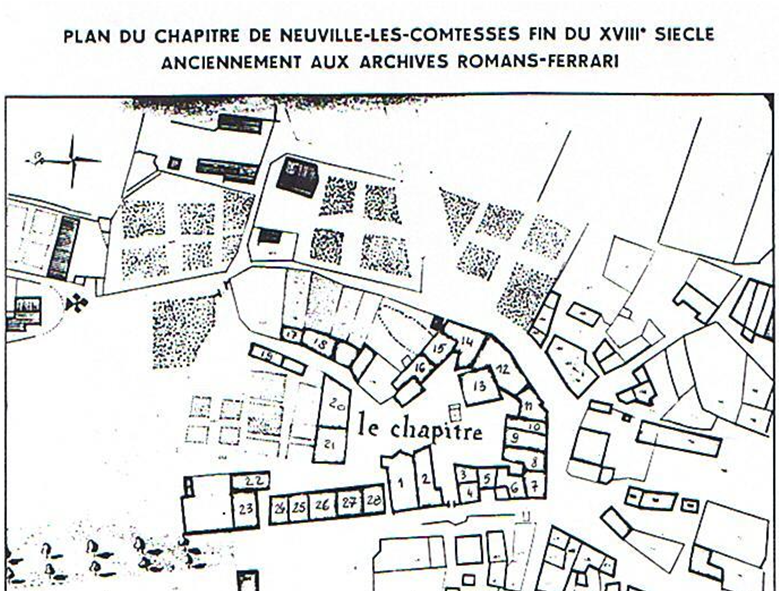
Chapter plan of Neuville-les-Comtesses, plan of Romans-Ferrari, The canonical houses, association of the church of Saint Maurice.
Why become a canoness?
Is it simply through religious conviction that one becomes a canoness in 1757?
No, beyond any religious conviction, the family thus ensured their youngest daughter a distinguished social rank, a refined education that she might not have had in her hometown, and, above all, the security of a lucrative benefice.
The prebend, what is it?
It is the "fixed income granted to a canon or a canoness"[5]. »
Indeed, they received a portion of the income from the abbey's revenues, so these positions as canonesses were highly sought after by certain noble families, somewhat short of funds (but they lost this advantage if they married).
What are the conditions? Research on genealogy and noble ancestors
To obtain the title at the chapter of Neuville-les-Dames, it was necessary, in addition to proving one's nobility over five generations, to justify 2000 livres of income and pay 1200 livres for reception costs and for the decoration of the church.[6]. The canonesses had to live in the chapter for 9 months of the year.
I did not find the exact amount of the prebend in this chapter. However, other chapters in Paris amounted to 852 livres annually.[7] or in Rennes between 600 and 1000 pounds[8].
If you are looking to learn more, I recommend thearticle de Dominique Masson "Quelques chanoinesses du Châtillonnais".

Photograph of the main facade of the Brasses house in Gevingey "the most beautiful in Neuville", Saint Maurice church association.
His parents Joseph Louis Christophe de Lucinge and Eléonore Charlotte de Sandersleben are aware of this chapter, an ancient Benedictine priory secularised since 1755 that allows for the reception of novices from the most prestigious families.[9]If his parents played a role in this decision, it is likely that his grandfather, Charles Léopold Sandersleben de Coligny, greatly influenced this choice. Indeed, according to the notice by Abbé Gourmand on the former noble chapter of Neuville-les-Dames, an inquiry was conducted in 1752 to determine whether the chapter should be closed due to insufficient annual income. Various individuals were consulted, including the canonesses as well as external testimonies. The aim was to reach a decision to keep the chapter open. Among the witnesses consulted was Charles Léopold.[10] Sandersleben de Coligny. His granddaughter, Louise Charlotte, is sent in this chapter.
Chanoinesse? What exactly is it?
According to the Le Robert dictionary, a canoness refers to a nun from certain communities.[11]However, according to the Académie Française, a canoness is "the name given to women who, without being religious, lived under the authority of a common rule, or who benefited from a prebend (fixed income) in a religious chapter of women." [12]».
According to Larousse, it is "a girl who, without making any vows, lived in a religious community."[13]". We observe that it is primarily an ecclesiastical and noble title.
But then, religious or not?
It all depends on the perspective taken. Although they observed the strict rules of their community on a daily basis, these ladies were not required to make solemn vows, which puts their full religious status into perspective.
The regulations of the chapter imposed on the canonesses an obligation to respect Christian morality: they were to observe exemplary modesty, limit themselves to edifying or instructive readings, and attend divine services dressed in their canonical habit.[14].
Moreover, celibacy was optional unlike for bishops, priests, or deacons. Marriage was possible and marked the exit from the chapter, which will be the case for Louise Charlotte who marries at the age of 24.
The story of Josephte Antoinette de Seyturier: genealogy and nobility
It is therefore on 8 May 1796, 18 years after her mother's marriage, that she was born amidst the turmoil of the French Revolution. This turmoil is confirmed as "her birth certificate having been lost during the revolution," as mentioned in a second document, had to be drawn up on 11 March 1825 in Thonon-les-Bains before the town's priest.
The revolution led to the closure of the chapters of canonesses in France, but this was not the case in Germany, which may explain the parents' intention to send their daughter to Germany. Indeed, through the study of her family's nobility in the Historical Armorial of Bresse, we learn that she will become a canoness of Saint Anne of Bavaria.[15]Since she grew up either in France during the revolution or in Germany, the documents proving her nobility do not exist in the cabinet of titles of the National Library of France.
Thus, we do not know exactly how, but her mother's connections in her youth at the chapter of Neuville les Dames may have granted her daughter this privilege. However, we know from her family tree that she is nonetheless of German nobility and from the prestigious "Wurtemberg" family through her great-great-grandfather, who was the duke. Her genealogy has undoubtedly worked in her favour to join this order.
Josephte Antoinette never married. Unlike her mother, she retained the title of canoness.

Excerpt from the memoirs of the Éduenne Society, January 1931, page 38.
The chapter of Saint Anne of Bavaria, research in the archives and German works
The specific sources regarding the chapter of Saint Anne of Bavaria are limited and in a Germanic language. However, one source will help us learn more.
This place, formerly an old convent, was officially established as a women's foundation. This initiative was taken on 19 September 1783 by Marie-Anne of Saxony. To be admitted, candidates had to be at least fifteen years old and be able to prove sixteen noble lineages. This number was reduced to eight after 1802.
The prebend was set at 1000 before 1802 and then at 500 after that date until 1825[16].
The eligibility of a candidate for a prebend was 10 years except in exceptional cases. We can therefore imagine
In the document below, we confirm that Josephte Antoinette de Seyturier is in the second class of the year 1825 at the Saint-Anne convent in Würzburg.
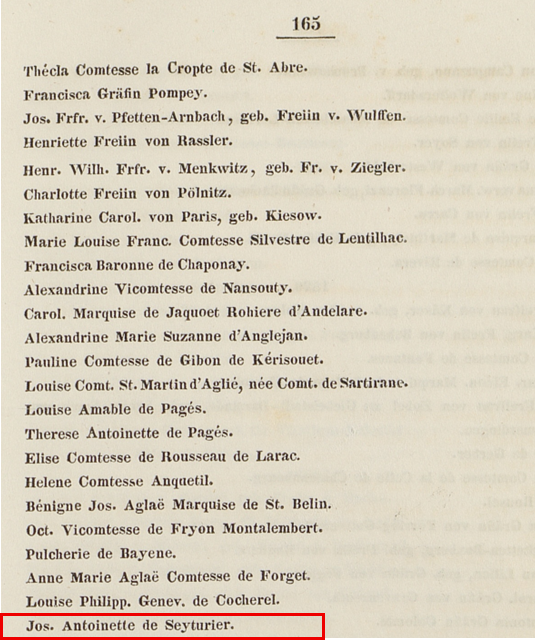
Extrait des sorties de l’ordre de Saint Anne de Bavière, 1825, Die Ritter-Orden, Ehren-Verdienst-Zeichen, sowie die Orden adeliger Damen im Königreiche Bayern, mit ihren Satzungen, geschichtl. Bemerkungen u. ihren dermaligen Mitgliedern, 1838, page 165.
Decoration - research in the old press
The publication in La quotidienne on 20 December 1820 shows that she has the permission of the King (of Bavaria) to wear the decoration of the royal chapter of Saint Anne of Munich.

Excerpt from the newspaper La quotidienne, 20 December 1820, page 3/4.
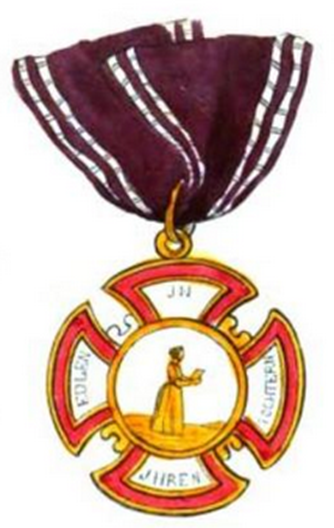
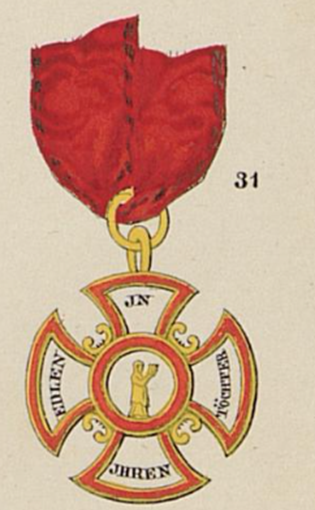
Extrait des sorties de l’ordre de Saint Anne de Bavière, 1825, 2ème classe, Die Ritter-Orden, Ehren-Verdienst-Zeichen, sowie die Orden adeliger Damen im Königreiche Bayern, mit ihren Satzungen, geschichtl. Bemerkungen u. ihren dermaligen Mitgliedern, 1838, page 184.
Here are two versions of the decoration of the royal chapter. The canonesses of Würzburg wore a modified version trimmed in red, with the inscription "IN IHREN EDLEN TÖCHTERN" which means "IN THEIR NOBLE DAUGHTERS". The most common attire was a black dress adorned with lace.
With the information found, we know that Josephte Antoinette received the decoration in 1820 from the King of Bavaria and she completed her journey in the Order of Saint Anne of Bavaria in 1825. However, she would retain this title until her death.
How to trace the family line? Focus on departmental archives
A claim for compensation[16] is available at the Departmental Archives of Ain and refers to the assets owned by the Lucinge family. This document aims to obtain compensation from the State for properties sold during the Revolution. Submitted on 30 August 1828 by Ferdinand and Gaspard Faucigny Lucinge, cousins of Josephe Antoinette de Seyturier. It is through this request that we find her trace as she is one of the applicants. Indeed, given that Éléonore Charlotte Sendersleben and her husband Joseph Christophe de Faucigny Lucinge have passed away, as well as their children Louis Amédée and Louise Charlotte de Faucigny Lucinge, it is the living descendants who will receive this "compensation". On 15 February 1830, another indemnity is mentioned, related to a liability of the Lucinge family. Josephe Antoinette requests an exemption from this debt, as it exceeds the amount of the compensation due to her. She wishes to be dissociated from the liabilities attributed to the heirs of Faucigny. This request aims to protect her own rights and to prevent the family liabilities from compromising the compensation she may be entitled to.
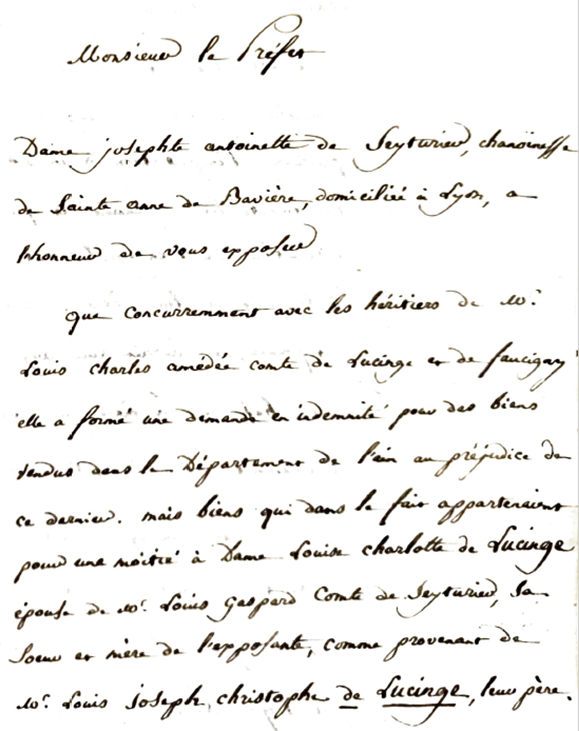
Transcription :
« Monsieur le Préfet,
Madame Josèphte Antoinette, chanoinesse
de Saint Anne de Bavière, domiciliée à Lyon, a
l’honneur de vous exposer
que concurremment avec les héritiers de M.
Louis Charles Amédée comte de Lucinge et de Faucigny
elle a formé une demande en indemnité pour des biens
vendus dans le département de l’Ain au préjudice de
ce dernier mais biens qui dans le fait appartenaient
pour une moitié à Dame Louise Charlotte de Lucinge
épouse de Mr Louis Gaspard Comte de Seyturier, sa
sœur et mère de l’exposante, comme provenant de
Mr Louis Joseph Christophe de Lucinge, leur père. »
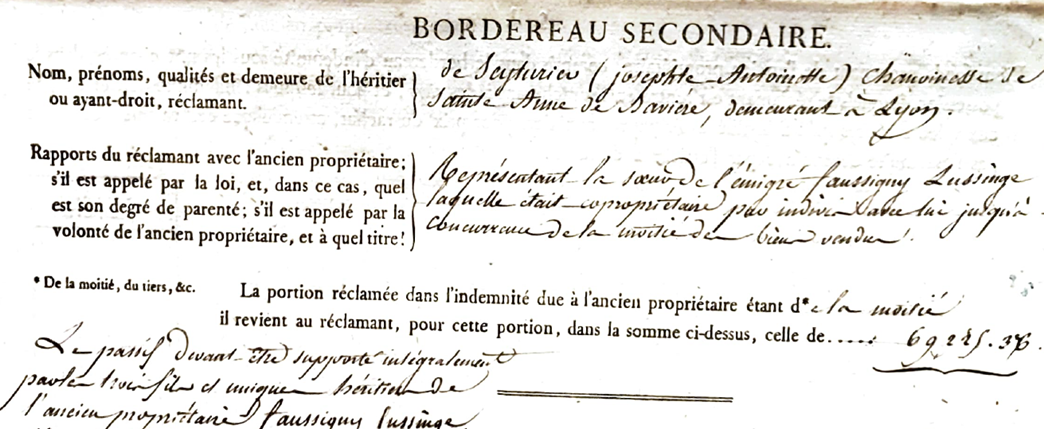
Claim request file, AD01, 1828-1832, 2Q83., page 18 and 30/43.
Ultimately, Josephe Antoinette will receive half of the compensation on behalf of the sister of the emigrant Faucigny, being an only child and not being required to pay the debts of Faucigny's heirs. She thus receives an amount of 69,225 francs and 36 centimes, which represents a considerable sum for her time.
Barely a year later, we find her trace on 20 April 1831 as she will request a inventory after the death of his father[18] This suggests that they had maintained ties, although her father resided in Paris while she lived in Annecy according to the document. Furthermore, the trail of the population censuses of Annecy does not allow us to find her since they only begin in 1861, as Annecy did not belong to France before this date and was under the administration of the Kingdom of Sardinia.
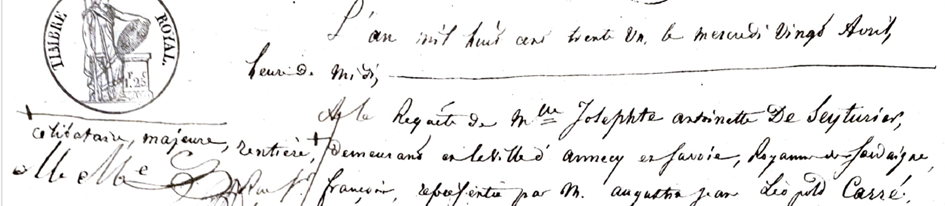
Extract from the minutes and registers of the notary Georges Champion, National Archives, Inventory after death of Louis Gaspard at the request of Josèphe Antoinette, MC/RE/LVI/23, page 1.
Transcription :
« L’an mil huit cent trente un, le mercredi vingt avril
Heure de midi
A la requête de Mademoiselle Josephte Antoinette De Seyturier,
Célibataire, majeure, rentière, demeurant en la ville d’Annecy en Savoie, Royaume de Sardaigne,
rue Saint François, représentée par Monsieur Augustin Jean Léopold Carré. »
Regarding Josephte Antoinette, we know that she indeed inherited from her father but also from her uncle, Alexandre Marie de Seyturier, as she appears on the inheritance tables[19] from the latter to Meximieux in 1851. The succession[20], registered on 4 June 1851 in Bourg, not only confirms this inheritance but also proves that she resided in Lyon, on the Croix-Rousse side.
She will end her life in Meximieux[21] on 14 June 1875, the very place where her uncle Alexandre Marie passed away. She will have therefore travelled from Munich in her youth to Annecy, Lyon, and then to Meximieux. Due to a lack of time, the exploration of her will and the inventories after death has not been conducted, although these sources promise to shed light on interesting leads regarding her inheritance and attachment to religion.
Unlike her mother and grandmother, Josephte Antoinette benefited from a more favourable fortune: she received a substantial share of the family estate through the compensation claimed and the inheritances from Louis Gaspard and Alexandre Marie de Seyturier.
Conclusion
Between historical and genealogical investigations, this study has allowed us to better understand the functioning of a chapter, as well as the conditions and motivations that led to becoming a canoness. We owe these discoveries to two figures: Louise Charlotte de Seyturier, associated with the chapter of Neuville-les-Dames in Ain, and her daughter Josephte Antoinette de Seyturier, who was linked to the chapter of Sainte-Anne of Bavaria, in Germany.
The prebend is the key element of the institution: a comfortable income paid individually to each canoness, derived from the chapter's property revenues, it guarantees the material independence of the prebendaries while conditioning their residence (at least 9 months/year in the chapter) and their attendance at services. Vacant due to marriage, renunciation, or death, it is highly sought after by noble families to endow unmarried younger daughters.
The lifestyle of a canoness, within a canonical house, cannot be equated with that of a priest bound by solemn vows nor with that of a strictly cloistered sister. It exists in a middle ground, halfway between religious commitment and worldly sociability, and pertains to a form of secular religion that, although situated outside a fully communal framework, maintains devotional practices, shared convictions, and a strong sense of spiritual belonging.
Indeed, regarding Josephte Antoinette de Seyturier's love for religion, we do not really know due to a lack of concrete evidence. However, we can think that her life was closely or loosely linked to religion, as evidenced by her act of generosity in bequeathing 2000 livres in her will to the work of the Dames du Calvaire in Lyon, a Catholic association dedicated to the care and support of women.
 Le salut Public, 25
juin 1876, Lectura Plus.
Le salut Public, 25
juin 1876, Lectura Plus.
Sources :
Photographie de couverture : Carte postale Neuville-les-Dames, Le chapitre, L. Ravier, édit, Bourg – Cl. A Cordier.
[1] Acte de naissance de Josephte Antoinette de Seyturier, Naissance, 1825, AD74, Thonon-les-Bains, 4 E 1763, 1819-1837.
[2] Acte de mariage de Louis Gaspard de Seyturier et Louise Charlotte de Faucigny Lucinge, Mariage, 1778, AD01, Bourg-en-Bresse, LOT11564, vue 66/120
[3] Collection Cherin, Lucinge, volume 125, Lucas-Lyons, Bibliothèque nationale de France, Gallica, 31687, vue 16/219.
[4] 269. Ain – SECULARISATION ET STATUTS du noble chapitre de Neuville les Dames en Bresse, Cabinet d'expertise Edgar Daval
[5] Définition de « Prébende », dictionnaire de l’académie Française, 9e édition.
[6] Notice sur l'ancien chapitre noble de Neuville-les-Dames, l'abbé A. Gourmand, page 16, consulté sur Gallica.
[7] Marie-Louise Queinnec, Les chanoines de Notre-Dame de Paris au xviiie siècle, Chapitre III. Revenus et modes de vie des chanoines, p. 155-188
[8] Olivier Charles, Chanoines de Bretagne, Chapitre VI. Les revenus des chanoines, p. 169-191
[9] Article « Neuville-les-Dames : histoire et patrimoine », patrimoines.ain.fr.
[10] Notice sur l'ancien chapitre noble de Neuville-les-Dames, L’abbé Gourmand, 1865, Bibliothèque nationale de France, Gallica, 8-LK7-12045, vue 13/33.
[11] Définition chanoinesse, Dictionnaire le Robert.
[12] Définition (ancienne) de Chanoinesse, Dictionnaire de l’académie Française, 9e édition.
[13] Définition chanoinesse, Dictionnaire le Larousse.
[14] Dominique Masson, "Quelques chanoinesses du Châtillonnais".
[15] Armorial historique de Bresse, Bugey, Dombes, Pays de Gex, Valromey et Franc-Lyonnais, d'après les travaux de Guichenon, d'Hozier, Edmond Révérend Du Mesnil, 1872, Bibliothèque nationale de France, FOL-LM2-217, page 652.
[16] Die Ritter-Orden, Ehren-Verdienst-Zeichen, sowie die Orden adeliger Damen im Königreiche Bayern, mit ihren Satzungen, geschichtl. Bemerkungen u. ihren dermaligen Mitgliedern, 1838, page 163-165.
[17] Dossier demande de réclamation, AD01, 1828-1832, 2Q83, vue 4-6/43.
[18] Minutes et répertoires du notaire Georges Champion, Archives nationales, Inventaire après décès de Louis Gaspard à la requête de Josèphe Antoinette, MC/RE/LVI/23.
[19] Table de succession d’Alexandre Marie de Seyturier, AD01, Meximieux, 1845-1856, LOT 138, vue 136/154.
[20] Renvoi, succession d’Alexandre Marie de Seyturier, AD01, 3Q, Bourg, 4 juin 1851, n°125.
[21] Acte de décès de Josephine Antoinette de Seyturier, AD01, Meximieux, 1874 - 1875, LOT59228, vue 29/44.