A hidden lineage revealed by DNA: investigation into François Mouyon
You have taken a DNA test and received dozens, if not hundreds, of matches… but you don’t know how to make use of them?
DNA genealogy today allows you to find an unknown ancestor and reveal hidden lineages that are impossible to identify with genealogy research alone.
Following the first article dedicated to the use of genetics to find an ancestor, I will present an investigation that, based on a few centimorgans, led me to discover a completely unsuspected branch of my family history.
The starting point: an intriguing match
It all begins with a DNA match on MyHeritage.
A certain Martine shares 223.7 cM with my mother’s profile (S.B.), which is about 3.2% of DNA.
A figure far from insignificant.

Example of a DNA match on MyHeritage, extracted from the DNA data between S.B and Martine, MyHeritage.
S.B is my mother’s profile, Martine is the name of the match.
A match of over 1% is already significant, so 3% indicates that we share a common ancestor within just a few generations.
This match shows that a moderate sharing of DNA can already reveal an exploitable family link.
Why testing your parents changes everything in DNA genealogy?
Testing only your DNA mixes the paternal and maternal branches. By testing your mother (approximately 3400+ cM transmitted) and your father, you instantly filter out 50% of irrelevant matches and double the shared centimorgans, increasing from 1700 cM to usable values.
For example, if I look at my report with Martine on MyHeritage, I am only at 0.9% shared DNA.
What DNA says (and does not say)
Tools like MyHeritage allow for automatic estimation of a relationship based on shared centimorgans.
In our case, several hypotheses emerge:
first cousin
parent's cousin
or even more distant relationships
But one thing is certain:
The common ancestor is likely between 5 and 7 generations ago.
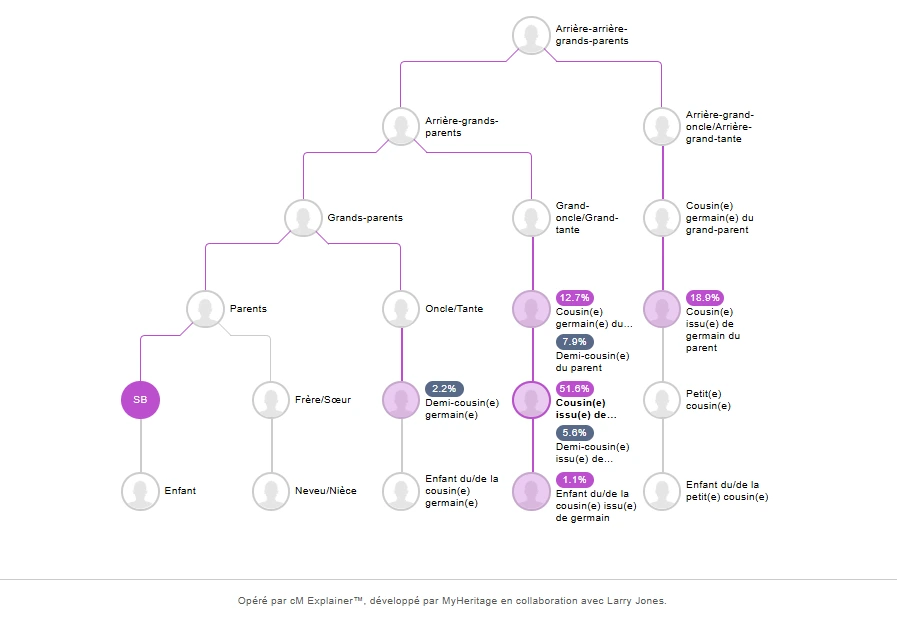
Estimation of relationships by MyHeritage, Extract from DNA data between S.B and Martine, MyHeritage.
However, this data may seem complex at first glance, which is perfectly normal. Their interpretation often requires perspective as well as a rigorous method. We have detailed this method in a first article and will now apply it through five steps.
Method: identifying a common relationship through DNA in 5 steps
1. Beginning of the investigation, understanding the relationship
The analysis of estimates allows us to locate the common ancestor at the level of great-grandparents or great-great-grandparents.
In the case of a complete relationship (involving both common ancestors), the probability reaches 84.3%. The most likely relationship is that of first cousin, with 51.6% (which corresponds to a gap of about six generations). Other hypotheses remain possible, such as a first cousin of the parent (a gap of five generations), a first cousin once removed of the parent, or even a child of a first cousin once removed (a gap of seven generations).
One might think that some of these hypotheses are unlikely, especially if the match is close to S.B.'s age. However, generations are not always perfectly aligned. It is therefore essential to delve deeper into the research before drawing definitive conclusions.
Finally, one must also consider a partial relationship, involving only one common ancestor. This hypothesis, although less likely (15.7%), remains quite credible.
2. Reconstructing family trees
DNA provides a direction, but it does not provide ready-made answers. In the majority of cases, it is essential to reconstruct family trees.
This work relies on the systematic verification of sources: civil status records, parish registers, archives. An error at this stage can skew the entire analysis.
In some cases, the common ancestor appears quickly. But more often than not, the available trees are incomplete. This is precisely the case here.
Martine's tree, although limited, does provide essential information: the names of her parents. From this information, I manage to identify a first lead via Filae:
Roger Chaix passed away in 1987 in Lyon. He was married to Eva Poirier.
This information remains fragile, as it relies on a third-party tree. It must therefore be verified.

Extract from Martine's family tree, MyHeritage
I then consult the death records from Insee (MatchID). Only one individual matches:
Roger Venant Chaix who died on 09/12/1987 in Lyon 8th

Extract from the death records, Roger Venant Chaix, INSEE, MatchID
The death certificate found in the municipal archives of Lyon confirms that he is indeed the husband of Carmen Eva Marie Poirier. Even with little information, archives often allow a search to be unlocked.

Death certificate of Roger Venant Chaix, 1987, no. 833, view 258/273, Lyon XVIII, AM Lyon
I continue with Carmen Eva Marie Poirier. Thanks to the cross-referenced information (all first names), I identify her death in 2008 in Francheville. However, her birth and death certificates are too recent to be freely accessible.

Extract from the death records, Carmen Eva Marie Poirier, INSEE, MatchID
I then have two options to obtain information about her lineage:
make a request for a death certificate from the municipality, the result of which will be sent by post
exploit the population censuses, particularly via the Filae platform.
Some censuses being indexed on Filae, it is sometimes possible to find the person sought. In this specific case, there is no trace of Carmen Eva Marie Poirier in the Lyon censuses of 1931.
On the other hand, a Carmen Poirier is recorded in Meyriat, in the Ain, in 1931. She is mentioned there as a boarder and seems to correspond to a person born in 1928 in Lyon IIe. Her status indicates that she was not living with her parents at that time.

Excerpt from the population census, Meyriat, 1931, L3905, view 4/7
We could look for the surname Poirier living in Lyon in the 1931 census, but we do not have sufficient information to identify her parents.
In parallel, I am submitting a request to the municipality of Francheville to obtain the death certificate of Carmen Marie Eva Poirier.
At this stage of the research, I notice that the birth certificate of Roger Venant Chaix, dating from 1911, is old enough to be accessible online on the departmental archives website. It allows me to easily reconstruct his entire ancestry. However, this does not have any common points with S.B.'s family tree.
Sometimes step two simply allows for the reconstruction of the family tree; sometimes it requires a little push and going through another often decisive step, communication.
3. Communicating with DNA matches
When the research hits a dead end, it becomes relevant to turn to the DNA matches themselves.
These platforms also function as exchange networks. Users can share valuable information.
In this specific case, I will ultimately not need to contact Martine.
The day after my request for the certificate, I receive a message on another platform, 23andMe.
A user, Joseph, contacts me to learn more about my genealogy.
An unexpected discovery thanks to DNA
My mother, S.B., has a match of 2.27%, or 165 cM, with a certain Joseph.
He contacts me to find out more about my own genealogy. As we exchange information, he shares the names of his grandparents with me. Immediately, I understand that the two matches are related.
This person confirms to me that:
His grandfather is Roger Venant Chaix
His grandmother is Carmen Eva Marie Poirier, born in 1928 in Lyon.
Carmen Eva Marie Poirier is the daughter of Adam Marius Poirier and Alexandrine Ailloud.
Martine, the match at 223 cM, is his aunt.
A few days later, I receive the death certificate requested from the town of Francheville for Carmen Eva Marie Poirier, which confirms the familial link mentioned by Joseph.
From there, I am able to easily reconstruct the branch of Martine's family tree by diving into the records of the departmental and municipal archives of Lyon.
The tree below presents the complete reconstruction of the tree:

Excerpt from Martine's family tree, 2023-asc-complete-colour, Généatique 2024, v1.3.5
4. Identify the common ancestor
By comparing S.B.'s family tree with Martine's, no common ancestor or couple of ancestors appears.
This type of situation can give the impression of an error. However, it is relatively common in genetic genealogy.
Archives tell a story. But the reality experienced by our ancestors can be very different.
In the face of this lack of correspondence, it becomes necessary to change approach. Rather than looking for an obvious common ancestor, we must identify indirect clues: places, periods, proximities.
The existence of a common surname between the two lineages
The presence of identical or geographically close places
Having not found common ancestors in our family trees, it seems relevant to rule out the hypothesis of complete kinship and instead focus on that of half-kinship.
In analysing the two trees, one element stands out. Among all my ancestors, only two lived in Lyon during the relevant period between 1890 and 1940.
François Mouyon, the protagonist I mentioned in a previous article, had been sentenced to prison for allowing a man to enter a lion's cage and witness, helplessly, his death under their claws.
Herminie Maria Berthod
Hidden lineages: what DNA reveals
The ups and downs of life meant that children could be born, wanted or not, from a biological father who was not necessarily the legal father mentioned in the records.
The mother often found herself bearing the weight of a pregnancy alone, without the support of a husband. It should also be remembered that contraceptive methods were almost non-existent at that time.
What is important to remember is that among the incredible number of ancestors we find in our family trees, some may have come from a conception where the biological father differed from the father recorded in the registers. It is thanks to DNA that it is possible to have a chance of identifying such cases.
No apparent common ancestor: what hypotheses to explore?
The absence of an apparent common ancestor should lead to considering alternative lineages, such as half-relations.
Two hypotheses then emerge in my mind:
1. Alexandre Charles Ailloud and Herminie Maria Berthod had a child together, Louise Francine Mouyon in 1914.
2. François Mouyon and Marie Louise Bréat had a daughter together, Alexandrine Ailloud in 1901.
I intuitively opt for the second hypothesis for several reasons:
Herminie Maria Berthod only arrived in Lyon between 1911 and her marriage in 1913.
François Mouyon is 17 years older than Herminie Maria Berthod. He has lived in Lyon since 1892.
He attempts to marry Benoîte Eléonore Subtil. Two marriage banns are published on 29 November and then on 5 December 1896, but the marriage will not take place. He marries for the first time on 24/11/1904 to Jeanne Jarrier.
He will have an illegitimate child with Benoîte Eléonore Subtil: Joseph Mouyon in Lyon on 24 June 1898. He will not be officially recognised by François until 25/04/1905.
Alexandrine Ailloud was not legitimised by her Alexandre Charles Ailloud at birth.
Alexandrine Ailloud was legitimised 11 days after her birth by her mother. She was therefore not 'wanted'.
Marie Louise Bréat and Alexandre Charles Ailloud married one year after the birth of Alexandrine Ailloud on 12/07/1902.
5. Making the archives speak through genealogical research
How to validate a hypothesis in DNA genealogy?
When it comes to an unwanted child, it is generally difficult to establish a link of filiation with certainty. Nevertheless, various clues and connections can be highlighted to support this hypothesis.
At that time, in cities like Lyon, travel was much more limited than today. Social relationships were mainly formed in the neighbourhood, at the workplace, or at the parish, where families, colleagues, and acquaintances often lived just a few streets apart.
Thus, I began to examine:
The addresses in the population censuses and military registration for men
The witnesses present in the records
This birth certificate provides a key clue about filiation and the family context.
“Recognised on 23 April 1901 by Bréat Marie Louise, legitimised on 12 July 1902 by Ailloud Alexandre”
“Marie Louise Bréat, 20 years old, vermicelli maker, 100 Cuvier Street”

Extract, birth certificate of Alexandrine Ailloud, AM Lyon, 2E 1854, view 104/187.
The military registration is a goldmine for locating a man since changes of residence had to be indicated. In the Mouyon file, there are no less than ten addresses recorded between 1896 and 1919.
The clue that puts us on the right track
One element quickly catches my attention: Cuvier Street.
This address appears both in the records of François Mouyon and in the birth certificate of Alexandrine Ailloud.
In January 1901, a few months before the birth, François Mouyon resides there.
In a city like Lyon, which then had about 450,000 inhabitants, the probability of finding two ancestors living on the same street is minimal. This type of coincidence is rare and difficult to attribute to chance.

Extract from the matriculation register of François Mouyon, 1 R 157
Check in the population censuses
As is often the case in archives, he appears under different first names (François or Joseph) and with several name variations (Mouyon, Mouillon, Moyon, Moujean), but his profession remains constant: painter. The objective is then to track his addresses from one census to another, despite frequent moves.
Thus, in the census, just four houses apart, Joseph Monjean, 28 years old, and Marie Bréa, 21 years old, appear, confirming their immediate proximity.

AD69, CUVIER (STREET), no. 100, 6 M 466, view 44/62

AD69, CUVIER (STREET), no. 104, 6 M 466, view 46/62
It is thanks to the cross-referencing carried out from the various censuses that our investigation was able to reach its conclusion. The intersection of sources allows a hypothesis to be transformed into solid evidence.
Particular case, the public assistance registers
One avenue to consider is that of an abandoned child in the lives of the individuals concerned. When an abandonment has already occurred, it is not uncommon for similar situations to arise, which may explain the emergence of an unknown branch revealed by DNA.
In the records, this is sometimes reflected by the mention of an ancestor born to unknown parents, or "without parentage". In this case, new avenues of research open up, particularly through the public assistance registers, preserved in the departmental or municipal archives.
In our case, several elements support this. François Mouyon already had an illegitimate child in 1898, three years before the birth of Alexandrine Ailloud. For her part, Marie Louise Bréat gave birth to another illegitimate child in 1902.
The hospital records also provide details. Marie Louise Bréat was admitted to the hospital of La Charité on 11 April 1901 and gave birth to Alexandrine on the same day. She left the establishment on 23 April, the date on which she acknowledged the child, while the child was placed in the hospice. Her address on Rue Cuvier is once again confirmed there.
The nursery journal[1] then mentions Alexandrine's discharge on 4 May 1901, information corroborated by the registers of assisted children[2].
The entirety of these documents not only allows for the reconstruction of the chronology but also helps to better understand the context of the abandonment and enriches the genealogical analysis.
End of the genetic genealogy investigation
I would like to thank Joseph, who provided me with numerous details about his family and thus enabled me to structure this article. In the interest of transparency, I wanted to present him with the full account of the investigation, particularly the story of Marie Louise Bréat.
Born on 5 June 1880 in Saint-Étienne[3](Loire) to an unspecified father and a mother aged 17, she became a noodle seller.[4]in Lyon.
At 21 years old, she gives birth to Alexandrine Ailloud, supposed daughter of François Mouyon, who, as we have seen, will only be recognised by her mother about ten days later, after being left at the Hôpital de la Charité.
On 21 April 1902, a new child, Jean Baptiste, is in turn abandoned at the Hôpital de la Charité and this time for good. On 7 June 1902, she marries Alexandre Charles Ailloud in Lyon.[5], who then acknowledges Alexandrine and Jean Baptiste at this marriage. The divorce is pronounced on 24 December 1924 in Lyon.[6], "at the request and for the benefit of the husband".
On 25 September 1931, she remarries Lucien Joseph Vernay in Villeurbanne.[7], who dies a month later, on 20 October 1931, in the same city.[8]. She then resides at the retirement home in Albigny-sur-Saône. Apparently pursued by misfortune, she is found drowned in Neuville-sur-Saône, opposite the Quai Pasteur, on 27 July 1948.[9].
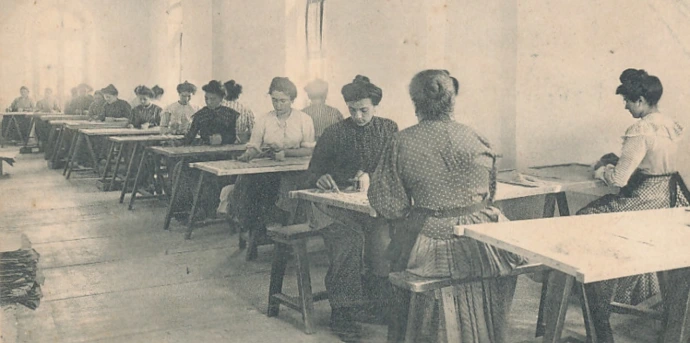
Vermicellerie ALBI, company of the great mills of Tarn, Delcampe.
Finally, we can conclude below with the family tree that illustrates the lineage between Martine, Joseph, and S.B., marking the half-relationship between the Bréat-Mouyon and Berthod-Mouyon branches with a pink and yellow line.
Conclusion
This investigation illustrates the full power of DNA genealogy when combined with genealogical research and communication with DNA cousins. From two matches of 223 and 165.9 centimorgans, it was possible to highlight a previously invisible lineage in traditional sources.
The approach was based on rigorous work reconstructing family trees, complemented by the use of key sources such as population censuses, in order to identify a point of convergence between the two lineages. Consulting a census from 1901, on Cuvier Street, François and Marie-Louise Bréat lived only four houses apart.
It finally reminds us of one essential thing: DNA does not replace archives, but it allows us to open new avenues and reveal family stories that have remained in the shadows. And you, what DNA lead will you explore tomorrow?
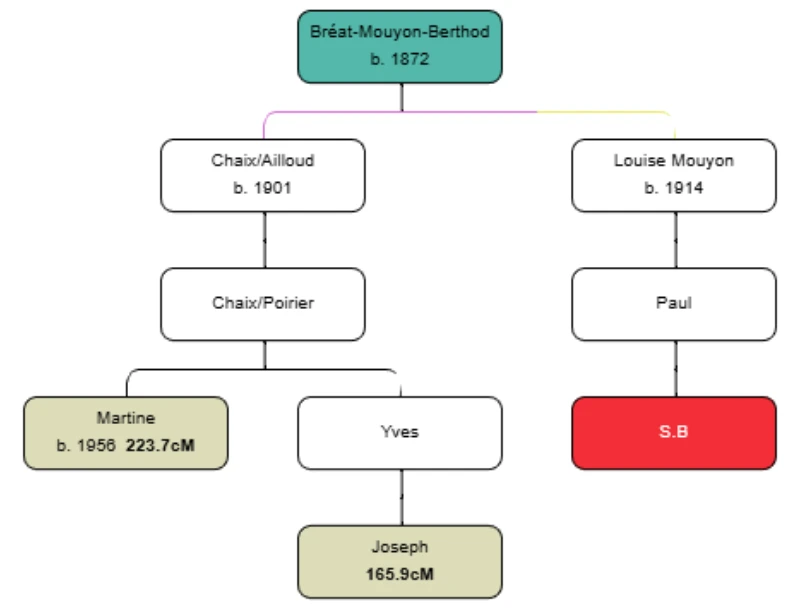
Diagram representing the relationship between Martine, Joseph, and S.B.What Are the Odds, DNA Painter.
Annexes:
[1] AM Lyon, Journal of entries to the nursery, 01/01/1901-31/12/1907, CH_6Q030, view 12/228
[2] AM Lyon, Alphabetical register of assisted children, 01/01/1901-31/12/1901, CH_4Q215, view 9/82
[3] Birth certificate of Marie Louise Bréat, Archives Saint-Etienne, 2 E 92, view 146/338
[4] Manufacturer of vermicelli and, more generally, pasta, National Centre for Textual and Lexical Resources
[5] Marriage certificate of Alexandre Charles Ailloud and Marie Louise Bréat, AM Lyon, Lyon 6th, 2E912, page 191/362
[6] Divorce decree between Alexandre Charles Ailloud and Marie Louise Bréat, AM Lyon 6th, 2E2530, page 135/419
[7] Marriage certificate between Lucien Joseph Vernay and Marie Louise Bréat, AD Rhône, 4E14341, view 135/195
[8] Death certificate of Lucien Joseph Vernay, AD Rhône, 4E14365, view 101/128
[9] Death certificate of Marie Louise Bréat, AD59, 1948, 4E19168, view 7/14
Cover photo: FELLETIN 23-Creuse Carpet Manufacturing Weaving Workshop 1915 of Sergeant FIS 342nd to Albertine Foix, Delcampe